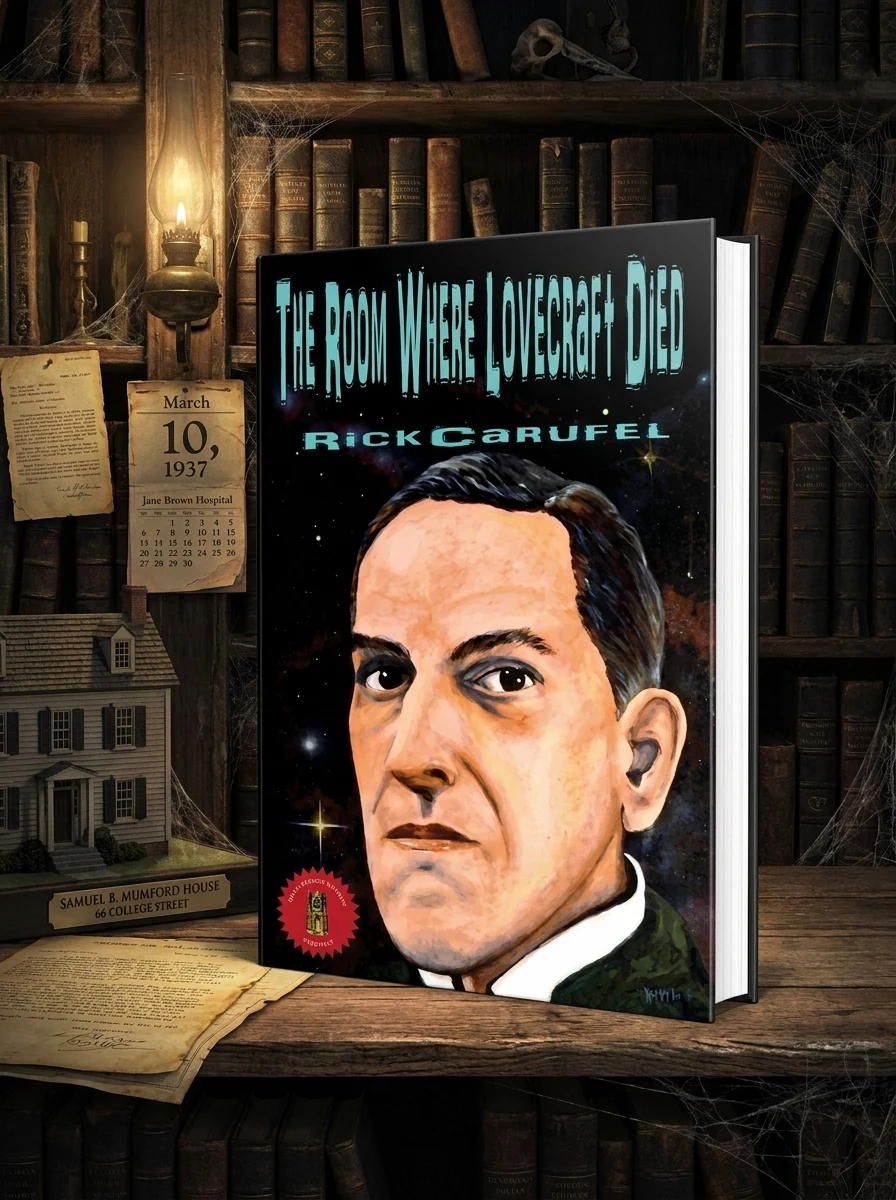
The Room Where Lovecraft Died.
A fictional account challenging the known facts of Lovecraft's death.
This work reimagines the final moments of Howard Philips Lovecraft through a supernatural lens. It focuses on the period around March 1937, specifically the time spent at the Samuel B. Mumford House and the Jane Brown Memorial Hospital. The narrative posits that the author died earlier than recorded, at 66 College Street, before being moved to the hospital. Carufel constructs a story where the location itself holds a horrifying secret. The book does not provide historical analysis but instead offers a fictionalized version of events. It appeals to readers who enjoy alternate history within the horror genre. The text is dense with specific references to the dates and locations involved in this alternative timeline.
The book engages with the legacy of Howard Philips Lovecraft, a central figure in American horror fiction. It references specific locations in Providence associated with his life and death. The narrative plays on the mystery surrounding his passing, using real addresses to ground its fictional claims in a recognizable historical context for fans of the genre.


📝 Description: The Room Where Lovecraft Died.
💎 Our verdict on The Room Where Lovecraft Died.
📖 Why choose it
Why this book is worth reading
Readers who enjoy speculative fiction that reimagines the death of famous horror writers will appreciate the perspective offered here. This book appeals to those interested in alternate history within the horror genre, offering a fictionalized version of events rather than historical analysis. It is suitable for fans of cosmic and psychological horror who wish to explore the legacy of Lovecraftian themes through a narrative that frames his passing within a horrifying truth. The text avoids broad generalizations, focusing strictly on the internal logic of its terrifying premise regarding 66 College Street.
⭐ Reader reviews
Reader rating
Rick Carufel presents a dense narrative challenging accepted history by positing Lovecraft died earlier than recorded. The book operates as supernatural fiction drawing upon gothic traditions, organizing an alternative history as factual revelation despite being fictional. It avoids academic citations, relying on the internal logic of its premise. Readers seeking verified biographical data will find this unsuitable. However, those interested in speculative fiction reimagining a horror writer's death may appreciate the specific focus on locations and dates involved in this timeline. The work succeeds as a focused exploration of cosmic horror tropes applied to a literary figure.
📖 Read on the blog
🏛 Books from this publisher Createspace Independent Publishing Platform




You might also like
See more →
Have a question about this item?
Ask about the edition, condition, delivery or anything else — we reply by email or phone, usually within a day.
