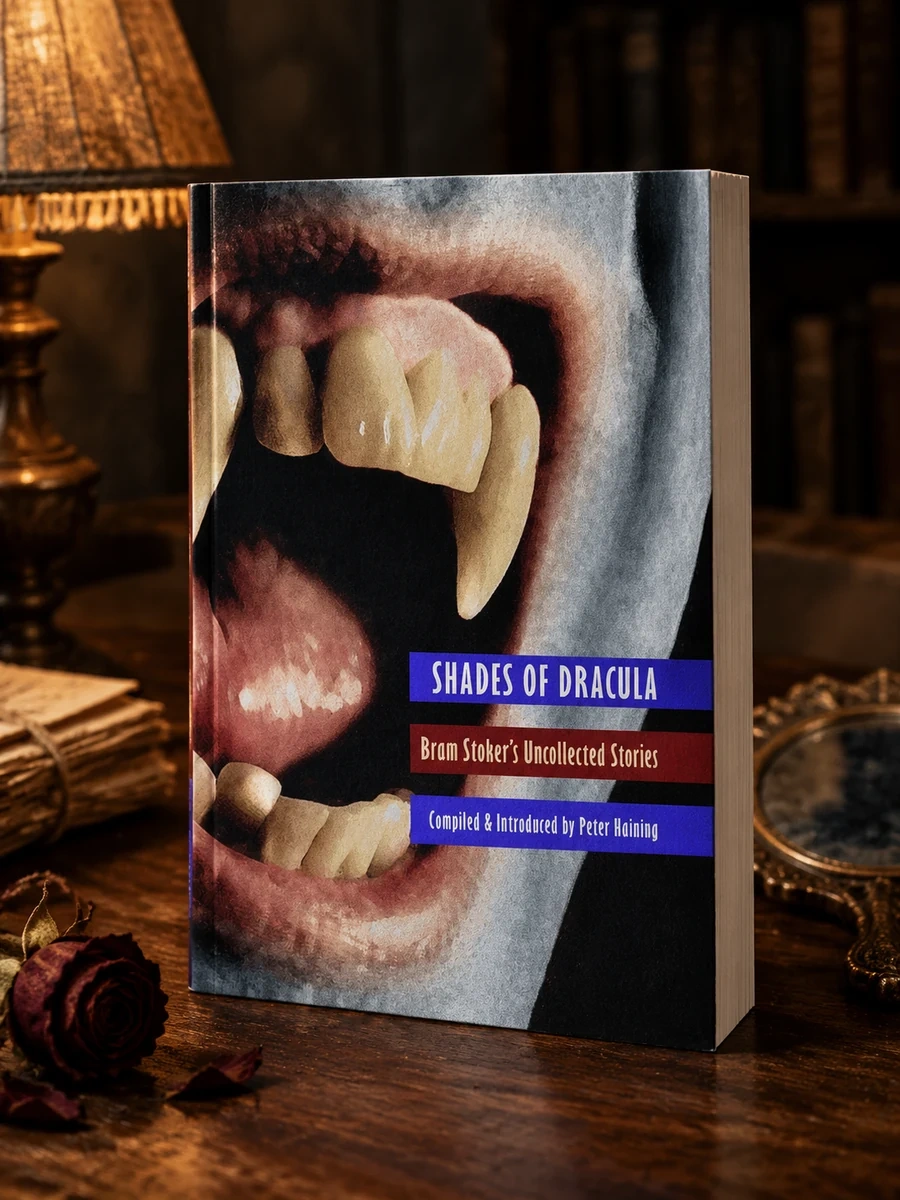

Shades of Dracula
A curated collection of Bram Stoker's stories linked to Dracula, arranged by Haining.
This volume gathers writings by Bram Stoker that connect to his vampire novel. Peter Haining organizes the material to show a chronological and thematic progression. Early stories reveal the author’s growing interest in supernatural elements. Later works demonstrate how that interest persisted after the main novel’s success. The collection does not include biographical details or external criticism. It focuses solely on Stoker’s own words. Readers can see how his mind worked through these connected pieces. The arrangement helps clarify the development of his gothic style. It is a resource for understanding the context of his most famous creation.
Published in 2006 by Apocryphile Press, this book sits within the tradition of literary scholarship focused on horror origins. It examines Bram Stoker’s work in the context of late nineteenth-century supernatural fiction, tracing his influence from pre-Dracula stories to his later writings.


📝 Description: Shades of Dracula
💎 Our verdict on Shades of Dracula
📖 Why choose it
Why this book is worth reading
Readers who trace the lineage of Gothic tropes will find value in this volume, as it offers a concrete look at how an author’s major work reshapes their entire output. It is designed for those interested in literary history rather than plot summaries, allowing them to observe patterns directly through primary texts. By presenting Stoker’s own words without critical distraction, the book helps audiences understand the persistence of themes in his mind. Those seeking a quick narrative summary will find little here; instead, it caters to readers who want to trace the roots and branches of Stoker’s imagination, witnessing how an initial spark grew into a lasting obsession with the vampire mythos.
⭐ Reader reviews
Reader rating
Haining’s approach is distinctly archival rather than analytical, selecting pieces that relate in some way to Dracula to create a narrative of creative development. The volume excels in its clarity, arranging texts to reveal a clear lineage of influence connecting early experiments with final reflections. It suits readers who appreciate the evolution of gothic style and wish to see how Stoker’s mind worked through connected pieces. By avoiding biographical details or external criticism, the book forces engagement with the source material itself. This method highlights the development of his gothic voice, making it an essential resource for understanding the context of his most famous creation without the noise of modern interpretation.
📖 Read on the blog
✍️ More books by this author Peter Haining


🏛 Books from this publisher Apocryphile Press
You might also like
See more →

Have a question about this item?
Ask about the edition, condition, delivery or anything else — we reply by email or phone, usually within a day.
