🩸Horror Tradition
Penanggalan
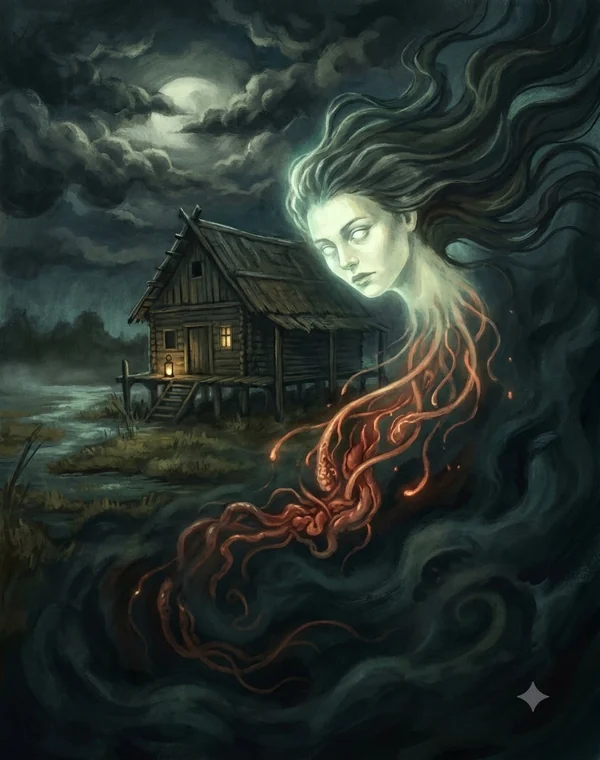
The penanggalan is a gruesome vampire-like entity from Malay folklore consisting of a disembodied female head trailing its dangling, glowing entrails.
Etymology & Origin
Where the word comes from
The name derives from the Malay root tanggal, meaning to detach or remove, referring directly to the disembodied head.
Full Definition
In depth
Origins The penanggalan originates in the traditional folklore of the Malay Peninsula and the wider Nusantara region, including parts of modern-day Malaysia, Indonesia, and Singapore. Rooted in oral traditions that stretch back centuries before being recorded by colonial-era and local folklorists, the legend typically describes a woman—often a midwife or practitioner of dark black magic—who pacts with demonic forces to achieve eternal youth or beauty. Through ritualistic meditation or forbidden occult practices involving vinegar, her human head detaches from her body, leaving the torso behind while her internal organs hang exposed beneath the neck, trailing behind her through the night air.
What It Is Said to Do In folklore, the penanggalan is an active nocturnal predator that preys primarily upon pregnant women and newborns. Because her trailing entrails glow with an eerie, phosphorescent light, she flies silently through the darkness like a glowing ball of fire until she spots a vulnerable household. She squeezes through narrow cracks or thatched roofs to feed on maternal blood and infant life force. To protect against her attacks, traditional communities hung thorny branches of the local mengkuang plant or thorny vines around the windows and under houses; the penanggalan's dangling intestines would snag on the sharp spikes, trapping her until dawn and exposing her human body left behind in the house.
In Horror Fiction In horror fiction and contemporary supernatural literature, writers use the penanggalan to tap into visceral body horror and psychological dread rooted in maternal vulnerability and bodily transgression. The horrific image of internal organs functioning independently outside the skeletal structure provides a striking visual departure from traditional Western vampires. Authors and short-story writers exploring Southeast Asian mythologies leverage the creature's duality—living as an ordinary human by day and a monstrous parasite by night—to build suspense within domestic settings, focusing on the paranoia of neighbors harboring ancient curses.
Why It Still Frightens This legendary spirit endures because it violently inverts the nurturing roles of motherhood and healing into a grotesque, predatory threat.
Connected Concepts
Related horror terms
Further Study