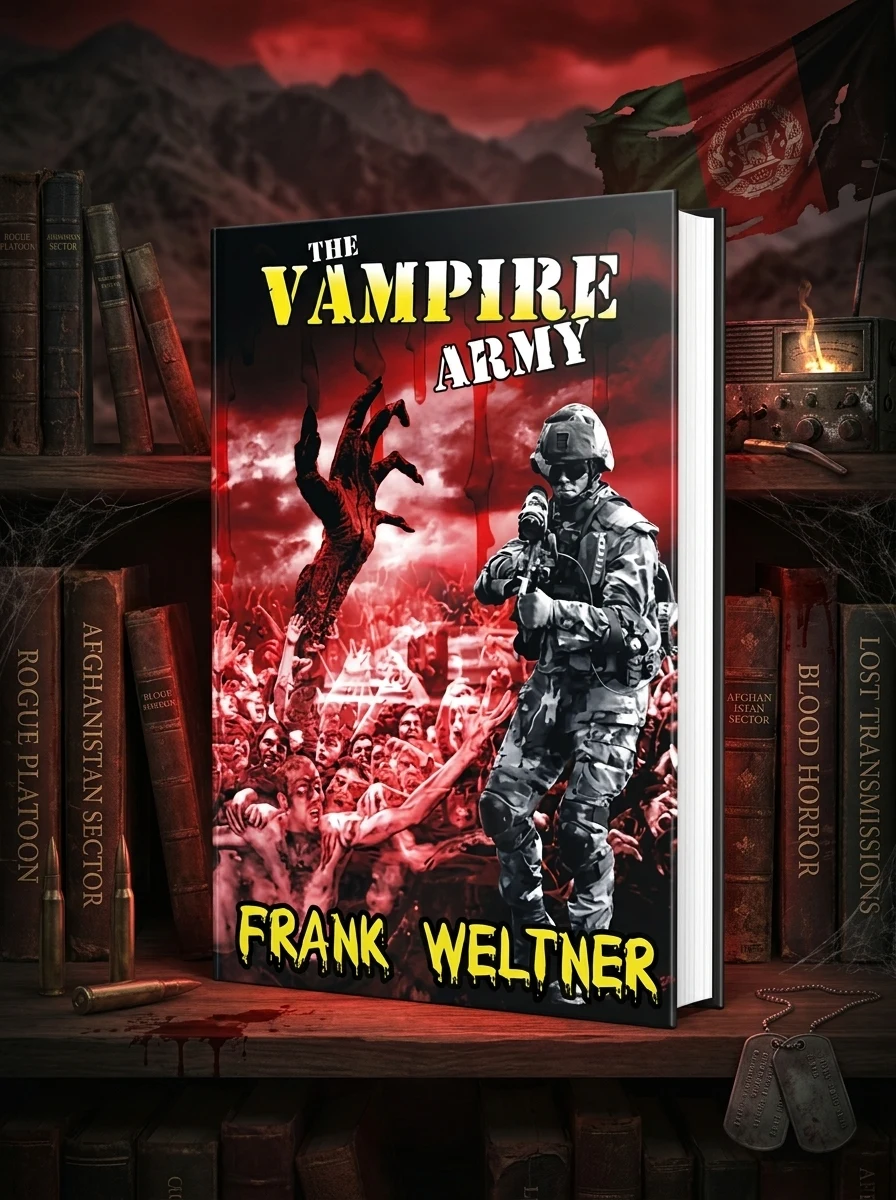
The Vampire Army
A rogue US Army platoon vanishes in Afghanistan amid supernatural horror.
The narrative follows a United States Army unit that has abandoned its orders in Afghanistan. Communication with this group ceases entirely upon entering new areas. Command structures fail to retrieve information or personnel. Rumors circulate about the fate of these soldiers while concrete facts remain scarce. The text implies that higher officials deliberately allow this army to disappear rather than face potential accountability for their actions. This secrecy protects those in power from knowing the extent of the devastation caused in the hinterlands. The story relies on the tension between official silence and the reality of what occurs in the field. It presents a scenario where the military itself becomes the source of the terror it is meant to combat.
The book was published in 2013 by Createspace Independent Publishing Platform. It engages with contemporary anxieties regarding military operations in Afghanistan and the potential for unchecked power within armed forces during modern conflicts.


📝 Description: The Vampire Army
💎 Our verdict on The Vampire Army
📖 Why choose it
Why this book is worth reading
Readers interested in the intersection of military fiction and supernatural horror will find this title compelling for its exploration of isolation and command breakdown. It appeals to those who enjoy stories where the source of terror is not external, but internal to the military structure itself. The book offers a chilling look at how rumors spread when facts are suppressed, creating a tense atmosphere of mystery. It is ideal for fans of cosmic or psychological horror who appreciate narratives focused on the consequences of unchecked power and the eerie silence surrounding vanished soldiers. The specific context of Afghanistan adds a layer of contemporary relevance to the classic trope of troops lost to otherworldly forces.
⭐ Reader reviews
Reader rating
Weltner effectively crafts an atmosphere of dread by focusing on the breakdown of communication and command rather than explicit supernatural details. The narrative excels in portraying the tension between official silence and field reality, making the military itself the antagonist. This approach suits readers who prefer psychological unease over graphic violence. While it lacks historical accuracy, it succeeds as a work of dark fantasy exploring government cover-ups. The story’s strength lies in its implication that higher powers prefer ignorance to accountability, deepening the horror. It is best for those seeking a mysterious, grounded tale of rogue soldiers facing hidden devastation in the hinterlands.
📖 Read on the blog
🏛 Books from this publisher Createspace Independent Publishing Platform




You might also like
See more →




Have a question about this item?
Ask about the edition, condition, delivery or anything else — we reply by email or phone, usually within a day.
