🩸Horror Tradition
Pooka
A legendary shape-shifting trickster spirit hailing from Celtic folklore, known for inhabiting lonely rural landscapes and bringing both unpredictable mischief and dark misfortune to unwary nocturnal travelers.
Etymology & Origin
Where the word comes from
Derived from the Irish word púca, meaning spirit or ghost, with older roots linked to the Middle English term puck.
Full Definition
In depth
Origins In traditional Irish folklore, the pooka—often spelled púca—stands as one of the oldest and most enduring figures of rural myth, with roots stretching back centuries across Celtic tradition. It belongs to a broader family of mischievous nature spirits found throughout Northwest Europe, sharing linguistic and thematic ties with similar entities in Welsh, Cornish, and Germanic folklore. Traditionally viewed as a creature of the wild, untamed countryside, the pooka was said to dwell in lonely places such as ancient hills, ruined forts, isolated bogs, and dark crossroads.
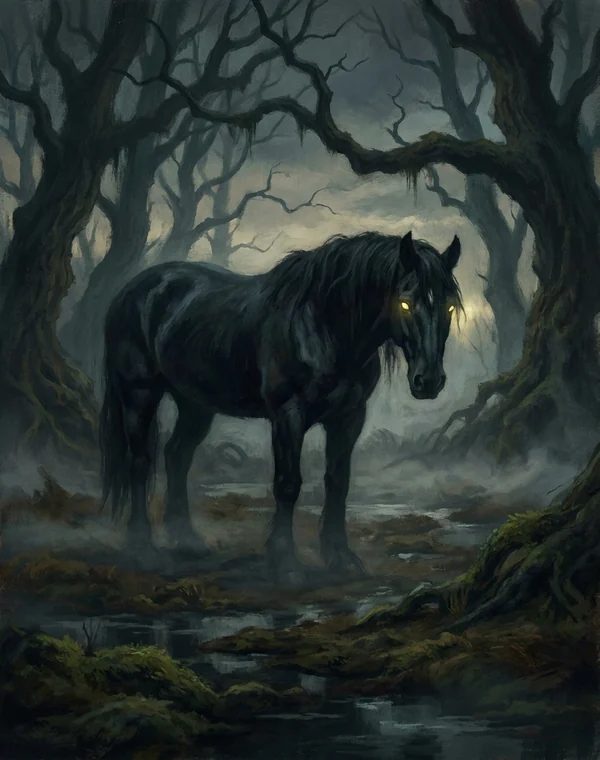
What It Is Said to Do In oral traditions, the pooka is described as a powerful shapeshifter capable of assuming the form of various animals, including sleek black horses, fierce goats, large hares, dogs, or even grotesque human-animal hybrids with dark fur, piercing eyes, and long ears. It is said to roam primarily at night, particularly around the harvest season and Samhain, playing cruel pranks on travelers by enticing them onto a terrifying midnight ride across ditches and briars before dumping them far from home. While some regional tales depict it as a neutral or occasionally helpful entity that might leave a blessing on a farm if a portion of the harvest is left behind as its share, older lore emphasizes its unpredictable capacity for chaos and distress.
In Horror Fiction In horror fiction and dark fantasy, writers utilize the pooka to evoke a deep-seated dread of the unknown and the perilous consequences of straying from the safety of civilization. Rather than a conventional monster of brute violence, the pooka embodies psychological terror, alienation, and the uncanny realization that nature is indifferent or actively hostile to human presence. Authors draw upon its shape-shifting ambiguity to blur the line between helper and tormentor, creating an atmosphere where ordinary pathways lead directly into nightmarish entrapment.
Why It Still Frightens Even in modern times, the pooka retains its power to unnerve because it preys on the primal human fear of being lost in the dark, reminding us that ancient, untamed forces still lurk just beyond the fringes of our ordered world.
Connected Concepts
Related horror terms
Further Study