🩸Horror Tradition
Barghest
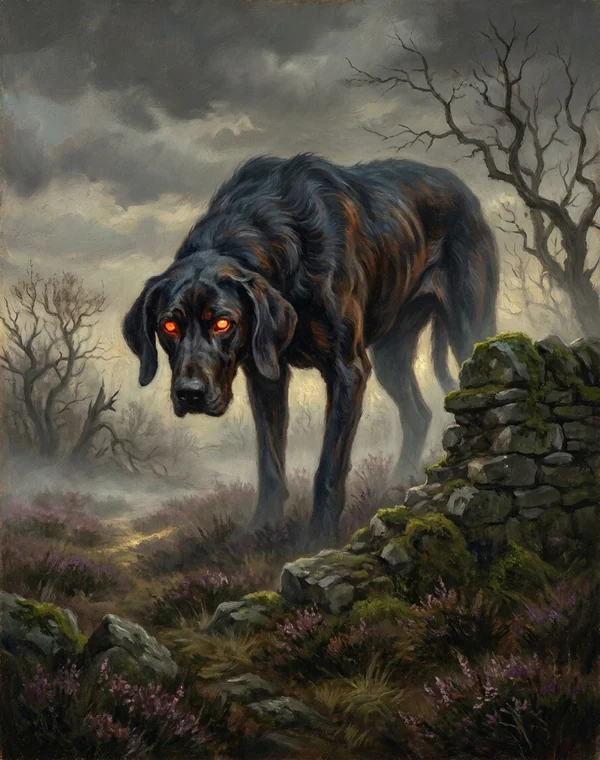
The barghest is a legendary monstrous black hound originating from English folklore, particularly associated with Yorkshire, known for its glowing eyes and ominous supernatural presence.
Etymology & Origin
Where the word comes from
The name barghest likely derives from the German dialect word for ghost, Berg-geist, meaning mountain spirit, or from the Germanic word for ghost combined with the northern English word for ghost, barghest.
Full Definition
In depth
Origins The barghest is a legendary creature deeply rooted in the folklore of Northern England, with especially prominent traditions in Yorkshire and the surrounding counties. Believed to have ancient origins in Anglo-Saxon and early Germanic mythologies regarding ghostly or demonic black dogs, the legend evolved across centuries of oral storytelling among rural communities. These accounts often blended older pagan beliefs concerning boundary-guarding beasts with later Christianized notions of demonic hounds patrolling lonely roads and churchyards.
What It Is Said to Do According to traditional lore, the barghest typically appears as a massive black hound possessed of enormous teeth, claws, and large, glowing eyes that burn like coals. It is frequently reported to haunt specific lanes, gates, and ancient burial mounds, often dragging a rattling chain behind it as it moves through the dark. Seeing the beast or hearing its sudden, piercing howl is traditionally interpreted as an omen of impending misfortune, severe illness, or death for the witness or someone close to them. In some regional variants, it has the power to vanish into thin air or transform into other shapes, making traditional physical defenses useless against its supernatural nature.
In Horror Fiction In horror fiction, authors utilize the barghest to evoke a deep, primal fear of the dark and the unknown wilderness, tapping into the classic trope of the monstrous hound that stalks isolated travelers. Writers employ the creature as a physical manifestation of guilt, fate, or ancient rural malice that modern civilization cannot tame. While many spectral hound appearances draw broadly from the archetype seen in works like The Hound of the Baskervilles, specific depictions of the barghest capture the grim isolation of the English moors and the suffocating dread of inescapable doom.
Why It Still Frightens This legendary hound endures because it preys on the universal, instinctual dread of predatory eyes watching from the dark shadows just beyond our firelight.
Connected Concepts
Related horror terms
Further Study