🩸Horror Tradition
Manticore
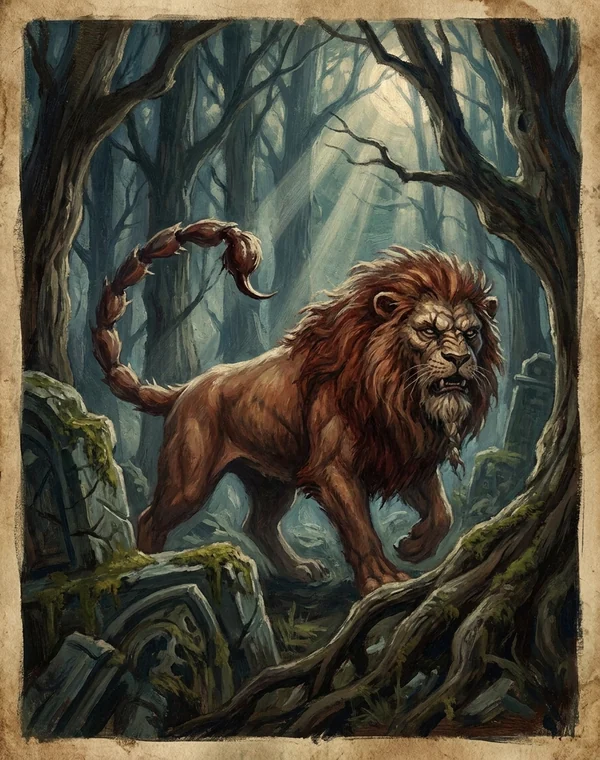
A legendary Persian beast with the body of a lion, human head, and venomous tail spines, originating from ancient Greek accounts of eastern mythology.
Etymology & Origin
Where the word comes from
Derived from the Old Persian martiya, meaning man, and khora, meaning eater, adapted through Greek into mantikhoras.
Full Definition
In depth
Origins The legend of the manticore traces back to ancient Persian folklore, introduced into Western classical literature primarily through the Greek physician Ctesias in his lost work Indica, written around the fifth century BCE. Ctesias recorded tales brought back from travelers concerning a strange beast feared in the royal forests and remote regions of ancient Persia. Later classical writers, including Aristotle, Pliny the Elder, and Pausanias, expanded upon these descriptions, treating the creature as a marvelous and terrifying wonder of the distant East. Over subsequent centuries, the manticore migrated into European bestiaries, where medieval scholars cataloged it alongside dragons, basilisks, and other monstrous inhabitants of uncharted lands.
What It Is Said to Do According to classical lore, the manticore possesses a monstrous composite anatomy: the body of a deep-red lion, three rows of teeth set in a human-like face, piercing blue eyes, and the tail of a scorpion or porcupine. It is renowned for its terrifying vocalization, which eerily mimics the sound of a fluting trumpet or a dying human voice to lure unsuspecting prey within striking distance. The creature can launch venomous quills or spikes from its flexible tail with deadly accuracy, paralyzing or killing anything it targets. Traditional safeguards against a manticore are virtually nonexistent in folklore, save for the sheer impossibility of outrunning it, as its appetite for human flesh is described as insatiable.
In Horror Fiction In modern horror and dark fantasy literature, authors deploy the manticore not as a mere zoological curiosity, but as a visceral embodiment of deception, unnatural hybridization, and predatory cruelty. The duality of its human face atop a savage beastly body provides a powerful metaphor for the hidden monster within humanity and the deceptive facades of the unknown. While many fantasy texts lean into its mythological roots, horror writers leverage its grotesque physiology and mimicry to evoke a deep sense of wrongness, capturing the dread of being stalked by something that mocks human communication while seeking to devour the flesh.
Why It Still Frightens This legendary beast endures because it violently shatters the boundaries between human identity and feral nature, weaponizing our own voice and visage into a lethal trap.
Connected Concepts
Related horror terms
Further Study