🩸Horror Tradition
Gashadokuro
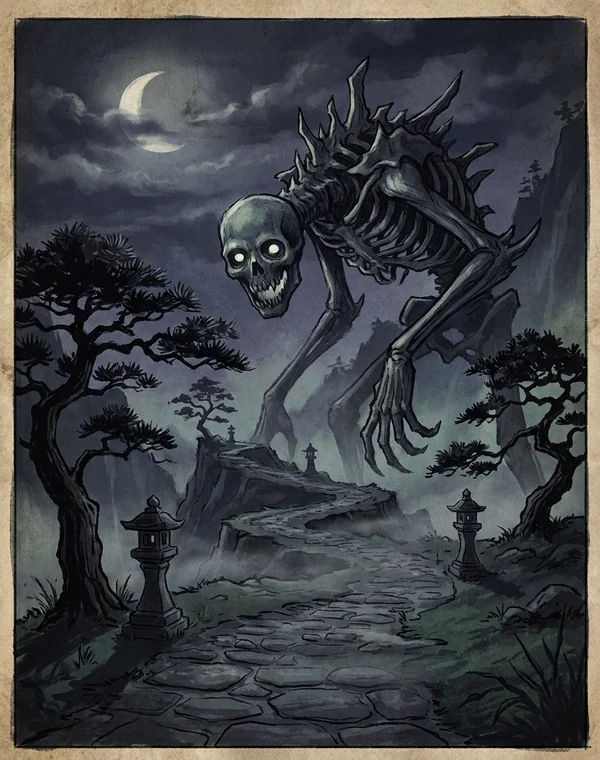
A giant skeleton spirit originating from Japanese folklore, formed from the amassed bones of people who died of starvation or perished forgotten on battlefields.
Etymology & Origin
Where the word comes from
Derived from Japanese roots, gasha mimics the clicking sound of bones, while dokuro translates directly to skull or skeleton.
Full Definition
In depth
Origins The gashadokuro is a terrifying apparition rooted in Japanese folklore and ghost stories, traditionally emerging from the collective agony of the unburied dead. While skeletal monsters and grotesque phantoms have populated Japanese oral traditions for centuries, the modern conception of the gashadokuro was largely popularized in mid-twentieth-century pop culture and literature, drawing heavy inspiration from classic ukiyo-e woodblock prints depicting giant skeletons. In Japanese myth, these towering entities do not arise from a single fallen individual, but rather from the combined skeletal remains of multitudes who perished from famine, plague, or slaughter during feudal conflicts. Because these victims received no proper death rites, funeral prayers, or grave markers, their residual anger, sorrow, and hunger coalesced into a singular, colossal mass of animated bone.
What It Is Said to Do According to traditional lore, the gashadokuro stands approximately fifteen times taller than an ordinary human, towering over rural landscapes and hidden mountain paths. It wanders the pitch-black hours of the night, driven by an insatiable, eternal hunger for human flesh and blood. As it stalks through the darkness, its massive joints make a loud, rhythmic clicking sound, described by the onomatopoeia gashagasha, which serves as the sole warning of its impending attack. If a gashadokuro spots a lone traveler, it reaches down with bony hands, grabs the victim, and bites off their head to drink their blood. Traditional folklore offered few practical defenses, though Shinto protective charms, sacred household talismans, and early morning temple bells were believed to ward off its hungry gaze.
In Horror Fiction In horror fiction and dark fantasy, writers utilize the gashadokuro to embody the overwhelming terror of collective trauma, historical neglect, and the consequences of mass violence. Unlike solitary ghosts tied to a specific grudge, this towering skeleton represents an ecological and cultural wound, a physical manifestation of suffering that society tried to sweep away and forget. While many depictions lean into action-oriented monster lore, sophisticated weird fiction uses its immense scale to dwarf human agency, highlighting the insignificance of individual characters against the crushing weight of ancestral karma. Because the creature's existence depends entirely on unaddressed historical grief, modern horror narratives often treat it as a vengeful reminder that buried atrocities cannot stay hidden forever.
Why It Still Frightens This monstrous skeleton endures as a terrifying symbol because it transforms forgotten tragedies into a relentless, physical force that cannot be reasoned with or outrun.
Connected Concepts
Related horror terms
Further Study