🩸Horror Tradition
Baba Yaga
Baba Yaga is a fearsome, ambiguous crone of Slavic folklore, originating in ancient oral traditions across Eastern Europe as a powerful forest-dwelling spirit.
Etymology & Origin
Where the word comes from
The name combines Slavic roots related to an old woman or grandmother with terms for a snake, terror, or witch.
Full Definition
In depth
Origins Baba Yaga is deeply rooted in the ancient oral traditions of Slavic folklore, particularly among Russian, Ukrainian, and Belarusian cultures. Long before being recorded by ethnographers in the nineteenth century, this enigmatic figure existed in pre-Christian mythology as a personification of nature, winter, and death. Scholars often connect her name and archetype to ancient forest guardians, ritual crones, or tribal priestesses who presided over rites of passage, serving as both a threshold guardian between life and death and a remnant of pagan animist beliefs.
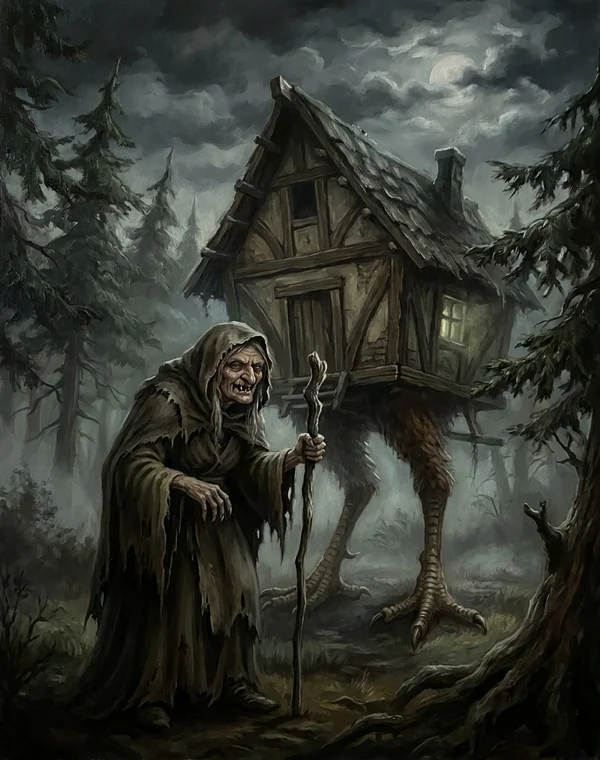
What It Is Said to Do In traditional lore, Baba Yaga is typically depicted as an ancient, grotesque hag with iron teeth, a skeletal frame, and sometimes a wooden leg, earning her the moniker of the Bony Leg. She travels not by foot, but by flying through the air inside a giant mortar while steering with a pestle, sweeping away the traces of her passage with a birch broom. Her dwelling is the iconic hut on chicken legs that spins around wildly to evade outsiders, fenced with human bones and skulls with glowing eyes. She is notoriously capricious, occasionally aiding pure-hearted seekers with magical wisdom, but more frequently kidnapping, cooking, and eating lost children or trespassers. Folklore suggests that protection against her wrath requires absolute politeness, clever riddles, offerings, or magical tokens provided by grateful animals.
In Horror Fiction Horror and fantasy writers frequently invoke Baba Yaga to explore themes of primordial dread, isolation, and the terrifying weight of ancient, untamable wilderness. In literature, she represents an adversarial force that tests the moral integrity and resilience of protagonists who stumble too deeply into the dark woods. Authors harness her dual nature—oscillating between unpredictable benefactor and ravenous monster—to subvert fairy tale expectations into genuine psychological and physical terror. Landmark works such as novels and dark fantasy adaptations draw heavily upon her folklore to anchor narratives in a deeply unsettling, folkloric uncanny valley where civilization offers no safety.
Why It Still Frightens Baba Yaga endures as an icon of terror because she embodies the primal fear of being devoured by the indifferent, dark wilderness and the terrifying unpredictability of ancient nature.
Connected Concepts
Related horror terms
Voices
Authors working in this mode
Further Study