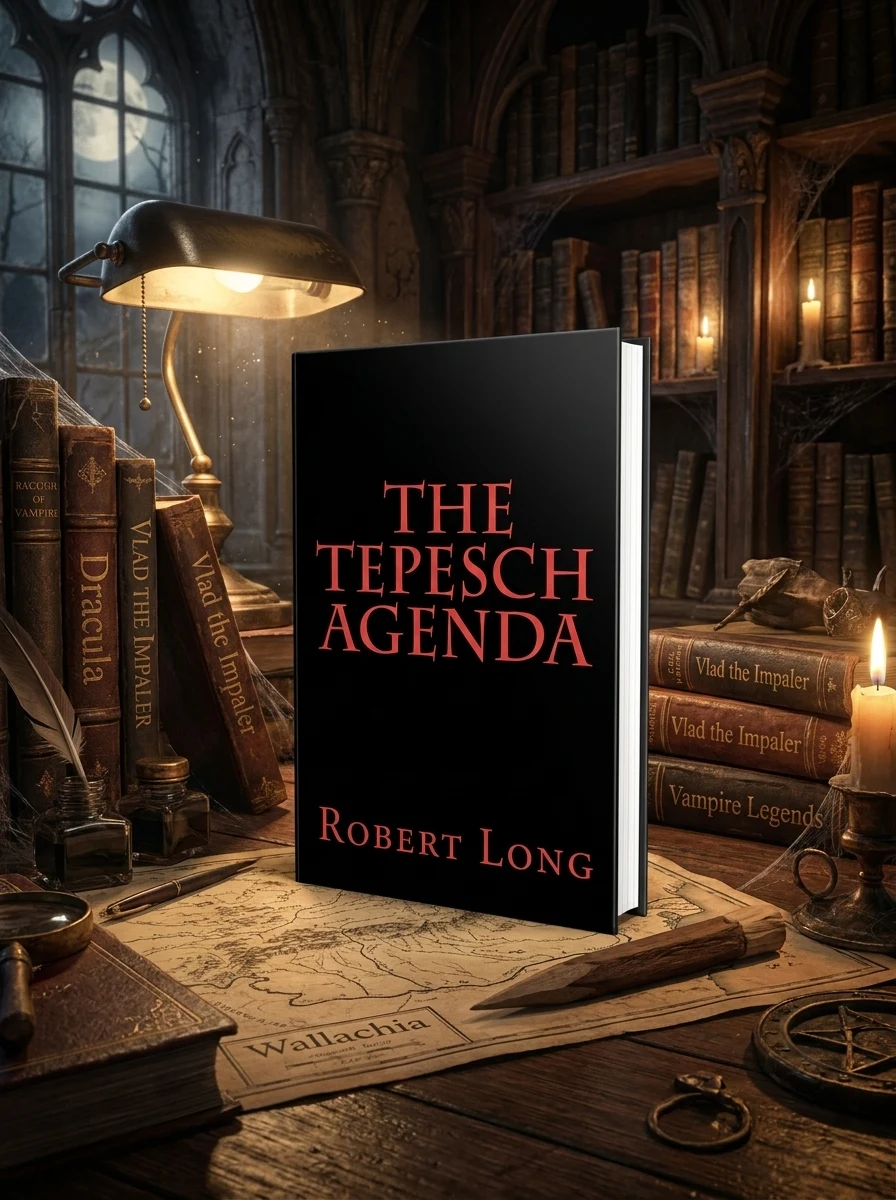
The Tepesch Agenda
A theory that Vlad the Impaler invented vampire fiction to hide his true existence.
Long posits that the historical figure Vlad the Impaler was a real vampire who engineered his own mythos. By telling his story to an author for publication as fiction, he created a widespread belief that vampires were imaginary. This disinformation campaign allowed vampires to operate in secret while controlling public perception through horror literature. The text investigates the psychological mechanisms behind this centuries-long deception and the specific tactics used to maintain their anonymity. It frames the entire genre of vampire fiction as a coordinated effort by the creatures themselves to obscure their reality from humanity.
The book engages with the legacy of Vlad the Impaler, the Wallachian tyrant who became the basis for one of the most iconic characters in horror fiction history. It addresses the cultural phenomenon of vampire lore in American and global media.


📝 Description: The Tepesch Agenda
💎 Our verdict on The Tepesch Agenda
📖 Why choose it
Why this book is worth reading
This book appeals to readers fascinated by the psychological underpinnings of supernatural folklore and the manipulation of media narratives. It is ideal for those who enjoy challenging the boundary between horror fiction and historical reality, offering a unique lens on the origins of vampire mythology. Readers interested in how disinformation can shape public perception will find value in its exploration of centuries-long deception. However, it may disappoint those seeking traditional fictional adventures, as the conceptual approach prioritizes theoretical investigation over plot-driven storytelling. It serves best for audiences curious about the intersection of history, psychology, and the horror genre.
⭐ Reader reviews
Reader rating
Long presents a provocative theory that Vlad the Impaler engineered his own mythos to hide his true existence. By framing vampire fiction as a coordinated disinformation campaign, the text offers a fresh perspective on the genre’s origins. It examines the psychological mechanisms behind this deception and the tactics used to maintain anonymity. The work is structured as an in-depth exploration rather than a simple interview, aiming to change how readers perceive the genre. While it lacks explicit details on the author's qualifications, its unique lens on vampire mythology is engaging. It suits those interested in folklore manipulation but may feel abstract to fans of conventional horror narratives.
📖 Read on the blog
🏛 Books from this publisher Createspace Independent Publishing Platform



You might also like
See more →

Have a question about this item?
Ask about the edition, condition, delivery or anything else — we reply by email or phone, usually within a day.
