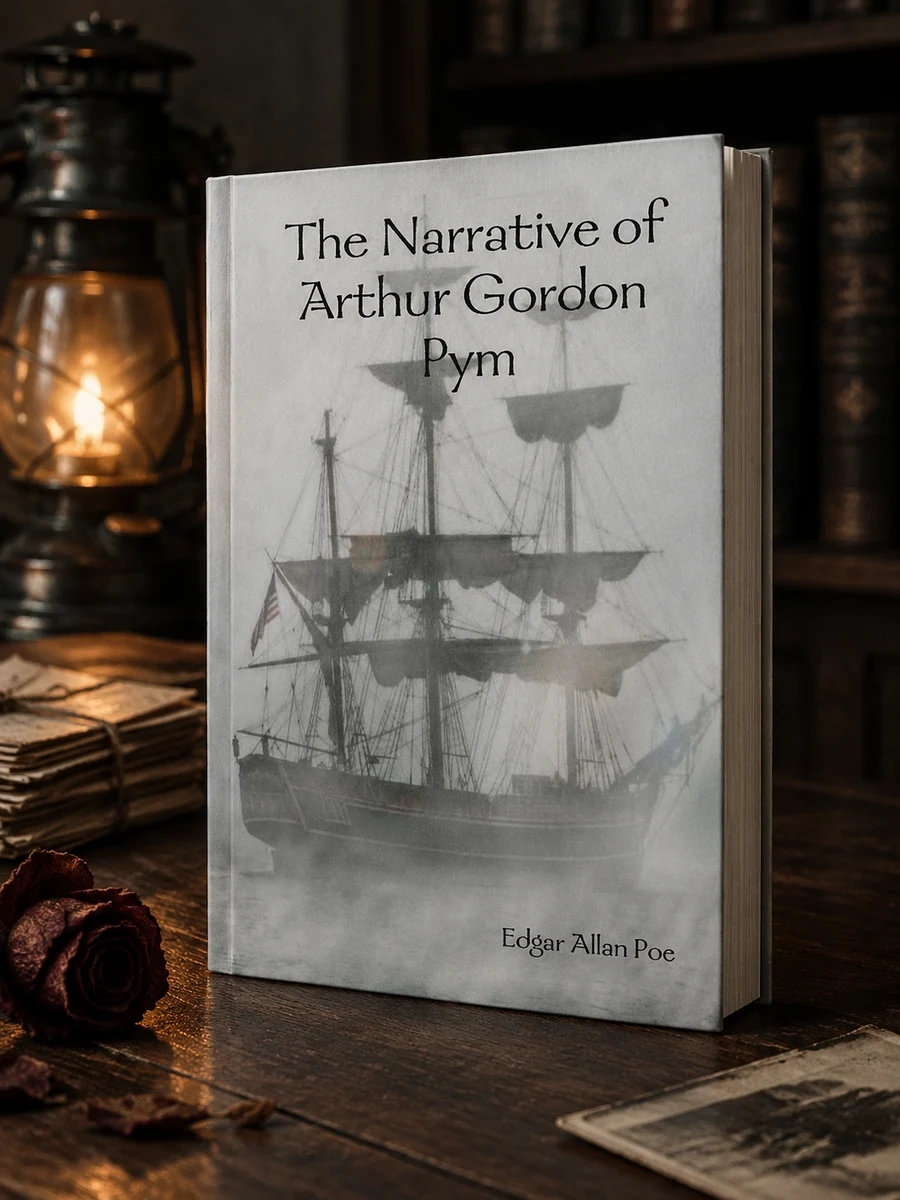

The Narrative of Arthur Gordon Pym
Poe's only novel follows a stowaway through grim sea adventures and survival.
The narrative centers on Arthur Gordon Pym, a New England youth who leaves home to join a whaling expedition. He hides aboard the vessel alongside Augustus, the captain's son. Their journey becomes a trial of endurance as they encounter mutiny and cannibalism. Poe uses this framework to explore how writers represent reality. The story avoids his characteristic poetic flair, opting instead for a restrained style that emphasizes the harshness of their situation. This approach creates a grim atmosphere that aligns with his other works despite the different genre. The plot moves through a series of dangerous encounters that test the characters' limits. It stands as an example of American escape literature and rite of passage storytelling.
This work is a pivotal piece in American literature, tracing a young man's escape from domesticity through a sea voyage. It draws on the tradition of the archetypal American story while addressing the problem of representing truth in fiction.


📝 Description: The Narrative of Arthur Gordon Pym
💎 Our verdict on The Narrative of Arthur Gordon Pym
📖 Why choose it
Why this book is worth reading
Readers interested in the evolution of American horror will find this text essential for understanding Poe's broader literary contributions beyond his famous short stories. It offers a unique glimpse into how a master of the macabre approached novel-length narrative structure. Those who appreciate grim realism and survival tales will enjoy the stark contrast to his usual poetic flair. The book suits fans of Gothic fiction who want to see how Poe explores the difficulty of representing truth through a stowaway's harrowing journey. It is ideal for scholars and enthusiasts examining the intersection of cosmic dread and human endurance in 19th-century literature.
⭐ Reader reviews
Reader rating
This novel successfully strips away Poe's characteristic luscious prose to deliver a grim, restrained account of survival at sea. The text effectively emphasizes the harshness of mutiny and cannibalism without resorting to his typical poetic tendencies. While it may disappoint those seeking his usual hair-raising horror short stories or lyrical style, it rewards readers with a distinct atmospheric shift. The work serves as an archetypal American rite of passage, testing characters through dangerous encounters that highlight the limits of human endurance. It remains a compelling study in how writers represent reality within the Gothic tradition.