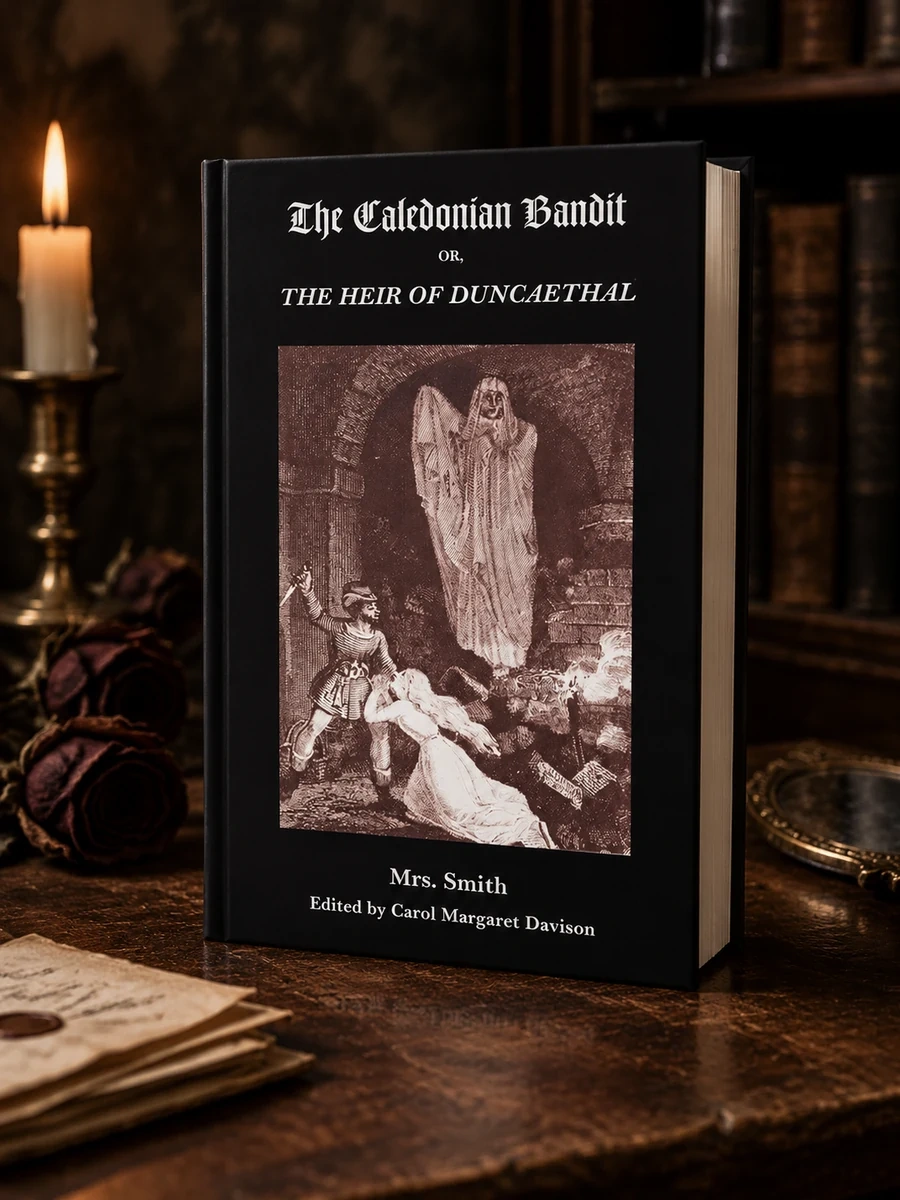
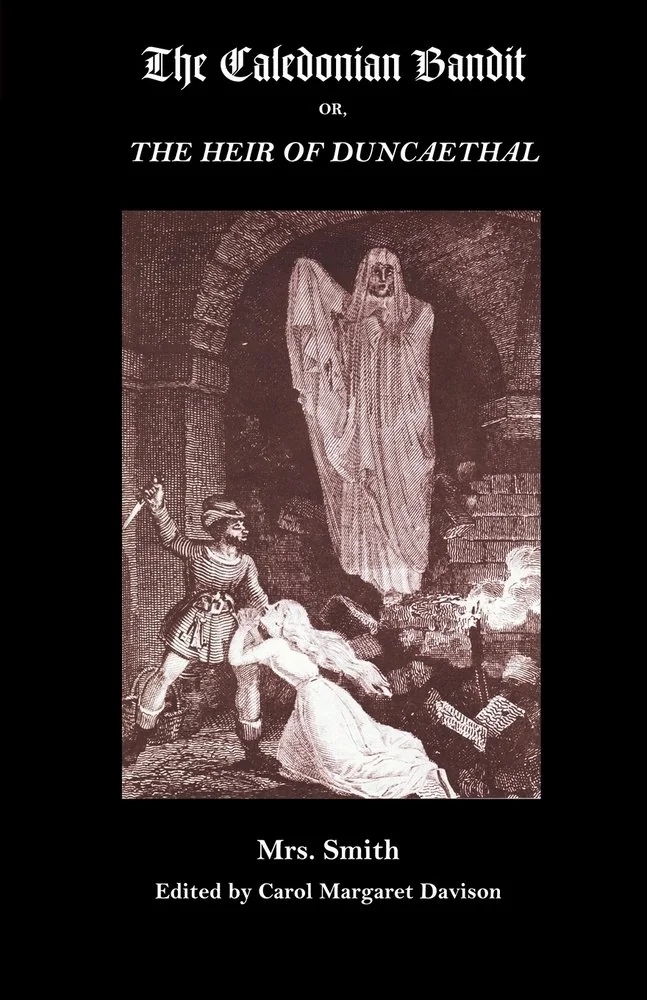
The Caledonian Bandit: Or, the Heir of Duncaethal, a Romance of the Thirteenth Century (Revised)
A revised edition of an 1811 Scottish Gothic novel featuring class conflict and three distinct villains.
Smith’s novel explores the intersection of romance and danger in medieval Scotland. Donald’s rescue of Matilda initiates a chain of events involving Lord Bosmora, Lady Margaret, Baron Duncaethal, and Darthalgo. The narrative examines how uncertain lineage affects social standing and romantic prospects. Davison’s introduction contextualizes the work within Scottish Gothic traditions. The edition preserves the original two-volume structure and includes scholarly apparatus such as notes and a bibliography. This approach allows readers to engage with the text as it appeared in 1811. The story highlights the power dynamics between nobility and peasantry. It also illustrates the role of mysterious figures in driving plot progression. Valancourt Books ensures accessibility for modern audiences while maintaining historical integrity.
Published by Minerva Press in 1811, this work represents a rare surviving example of early nineteenth-century Scottish Gothic fiction. The revised edition by Valancourt Books restores the original text, offering insight into how supernatural themes were woven into romantic narratives during this specific literary period.


📝 Description: The Caledonian Bandit: Or, the Heir of Duncaethal, a Romance of the Thirteenth Century (Revised)
💎 Our verdict on The Caledonian Bandit: Or, the Heir of Duncaethal, a Romance of the Thirteenth Century (Revised)
📖 Why choose it
Why this book is worth reading
Readers interested in the evolution of Gothic literature will find significant value in this text, particularly those studying the intersection of class conflict and supernatural terror in early nineteenth-century Scotland. The narrative offers a compelling look at how uncertain lineage drives romantic and social complications during this era. Scholars of Minerva Press publications will appreciate the preservation of the original two-volume structure and the scholarly apparatus provided. It serves as an essential resource for understanding how Scottish settings influenced supernatural narratives, providing historical integrity and literary context without modernization or abridgment.
⭐ Reader reviews
Reader rating
Smith’s novel effectively captures the essence of the Scottish Gothic tradition through its focus on medieval power dynamics and mysterious antagonists. The convergence of three distinct villains creates a palpable tension between social barriers and supernatural undertones. Valancourt’s edition is commendable for restoring the unabridged text, allowing modern audiences to engage with the author’s original voice. The inclusion of Carol Margaret Davison’s introductory essay provides necessary context for scholars. While the plot relies on familiar Gothic tropes, the historical setting and exploration of class struggle offer a fresh perspective for enthusiasts of early horror fiction and romance.


![The Mysteries of London, Vol. I [Unabridged & Illustrated]](/img/the-mysteries-of-london-vol-i-unabridged-illustrated-40029-scene.webp)