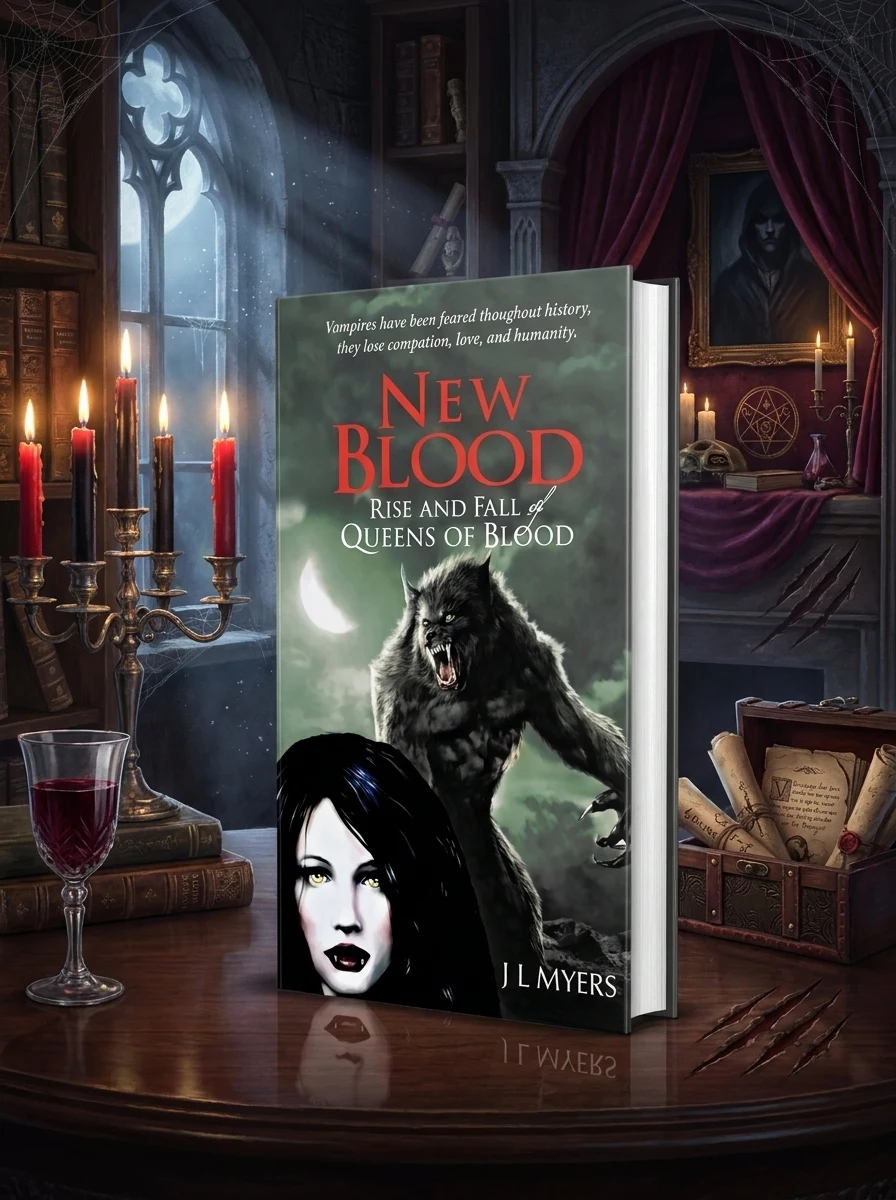
New Blood: Rise and Fall of Queens of Blood
A political thriller set in an Invisible Empire ruled by Vampire Queens.
Myers constructs a narrative where power is not given but taken through dangerous bargains. The rise and fall of queens suggests a cyclical nature of control, where each ruler faces the threat of being overthrown. The book examines the psychological toll of maintaining authority in a society built on secrecy. It portrays the Vampire Queen not as a distant myth but as a political actor making calculated moves. The story emphasizes that survival depends on understanding the hidden rules of the Invisible Empire. Myers uses the framework of gothic horror to critique the nature of power and loyalty.
Published in 2012 by iUniverse, this work sits within the contemporary American market for supernatural fiction. It engages with established gothic traditions while focusing on modern political metaphors within a vampire hierarchy.


📝 Description: New Blood: Rise and Fall of Queens of Blood
💎 Our verdict on New Blood: Rise and Fall of Queens of Blood
📖 Why choose it
Why this book is worth reading
Readers who appreciate the intersection of supernatural lore and intricate political maneuvering will find significant value in this narrative. The book appeals to those interested in exploring how power is seized and maintained through dangerous bargains rather than inherited privilege. It offers a deep dive into the psychological toll of authority within a society built on secrecy, making it ideal for fans of complex character dynamics over simple hero journeys. Those who enjoy fragile alliances, contested power structures, and the moral ambiguity inherent in survival scenarios will gain from its focus on hidden rules and calculated moves. The text provides a critique of loyalty and ambition, rewarding readers who engage with the layered deceit defining the vampire hierarchy.
⭐ Reader reviews
Reader rating
Myers effectively utilizes gothic frameworks to critique the nature of power, presenting the Vampire Queen as a tangible political actor rather than a distant myth. The narrative succeeds in depicting the psychological weight of maintaining authority within an Invisible Empire, where survival depends on understanding hidden rules. While it lacks straightforward hero narratives, offering instead moral ambiguity and no easy resolutions, this complexity serves its purpose well. The story excels in portraying the intricate web of deceit that defines the hierarchy. It is best suited for readers seeking political intrigue within the supernatural genre, particularly those who enjoy contested power structures and dark pacts over simple action.
📖 Read on the blog
🏛 Books from this publisher iUniverse



You might also like
See more →


Have a question about this item?
Ask about the edition, condition, delivery or anything else — we reply by email or phone, usually within a day.
