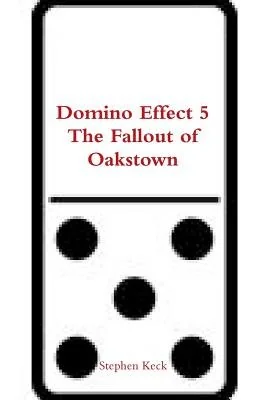
Domino Effect 5 The Fallout of Oakstown
A novel about a son and seven friends dying in predicted order at a ruined town.
This work focuses on the generational impact of a catastrophic event. Maggie Ivey’s initial vision sets the stage for a tragedy that unfolds decades later. Her son Thomas leads a group to Oakstown, unaware that their lives are bound to her past observations. The narrative tracks the systematic elimination of these eight individuals. It raises questions about causality and the nature of premonition. The story does not offer easy answers but rather immerses the reader in the characters’ struggle against an inevitable fate. Keck uses this framework to examine how trauma persists across time. The book is a fictional exploration of consequence, where the past actively shapes the present in violent ways.
Published by Lulu.com in 2016, this work sits within the tradition of independent horror publishing. It engages with American anxieties about environmental disaster and municipal failure. The setting of Oakstown reflects a localized fear of invisible threats lingering in familiar spaces.


📝 Description: Domino Effect 5 The Fallout of Oakstown
💎 Our verdict on Domino Effect 5 The Fallout of Oakstown
📖 Why choose it
Why this book is worth reading
Readers interested in the psychological weight of inherited trauma will find this narrative compelling. It appeals to those who enjoy supernatural frameworks that interrogate causality and premonition without offering easy answers. The book is suitable for audiences drawn to stories where the past actively shapes the present in violent ways. It offers a fictional exploration of consequence, focusing on the struggle against inevitable fate rather than providing historical accounts or non-fiction analyses. Fans of cosmic horror and gothic themes will appreciate the tension between prediction and reality as characters confront their predetermined ends.
⭐ Reader reviews
Reader rating
Keck structures this narrative around the intense tension between prediction and reality, forcing characters to confront a fate they did not choose. The work effectively examines the lingering effects of radiation and inherited trauma through a supernatural lens. It succeeds in immersing readers in the characters' struggle against an inevitable outcome, raising profound questions about the nature of premonition. The approach is best suited for those interested in family sagas intertwined with speculative elements. Readers seeking straightforward historical accounts or non-fiction analyses of nuclear safety may find the fictional framing less suitable. The text resolves its mysteries through specific experiences rather than abstract theory.