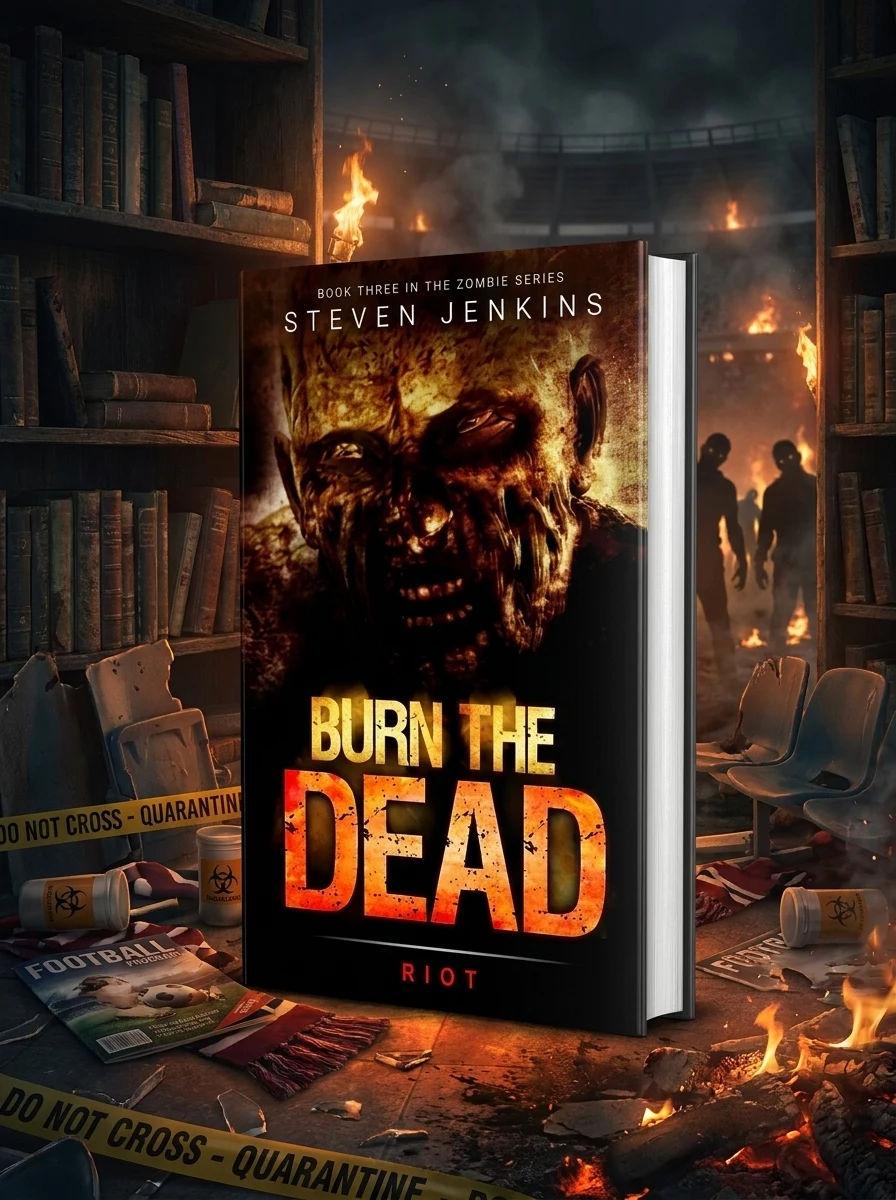
Burn The Dead: Riot (Book Three In The Zombie Saga)
A zombie outbreak traps fans in a sealed stadium.
Riot continues the saga by focusing on Alfie Button during a catastrophic event at a sports venue. Jenkins places his protagonist in a high-density environment where safety vanishes instantly. The virus transforms spectators into attackers, creating a scenario where escape is impossible. The author emphasizes the collective panic of twenty-one thousand people rather than individual heroics. This approach highlights the fragility of social order when faced with an overwhelming supernatural threat. Jamie White notes the strength of the characterization within this chaotic setting. Jenkins ensures that the stakes feel personal despite the scale of the disaster. The narrative does not rely on complex lore but on immediate physical danger. Readers experience the story through the eyes of teenagers forced to adapt quickly. The lack of external help adds to the despair. Jenkins structures the plot around the progression of the outbreak and the failure of containment. This method keeps the tension high without unnecessary exposition. The book offers a concentrated look at survival instincts in a confined space.
Published by Different Cloud Publishing in 2016, this work sits within the contemporary American horror tradition. It draws on the popular trope of the undead uprising in modern public spaces. The story reflects anxieties about viral contagion and crowd control failures in large venues.


📝 Description: Burn The Dead: Riot (Book Three In The Zombie Saga)
💎 Our verdict on Burn The Dead: Riot (Book Three In The Zombie Saga)
📖 Why choose it
Why this book is worth reading
Readers who prefer character-driven horror over slow-burn dread will find significant value in this narrative. It appeals to those who enjoy fast-paced supernatural fiction with a focus on group dynamics under extreme pressure. The book is ideal for audiences seeking immediate physical danger and claustrophobic tension rather than gentle romance or historical accuracy. By centering on teenagers forced to adapt quickly, it offers a concentrated look at survival instincts in a confined space. The lack of external help and sealed exits creates a desperate atmosphere that highlights the collective panic of the crowd. Those who appreciate real characterization within chaotic settings will gain from the exploration of how ordinary people react when safety vanishes instantly.
⭐ Reader reviews
Reader rating
Jenkins constructs a compelling narrative by placing his protagonist in a high-density environment where escape is impossible, amplifying the sense of entrapment through the stadium setting. The author emphasizes the collective panic of twenty-one thousand people rather than individual heroics, highlighting the fragility of social order under supernatural threat. Jamie White notes the strength of characterization within this chaotic backdrop, ensuring stakes feel personal despite the disaster's scale. The plot relies on immediate danger and the failure of containment to maintain high tension without unnecessary exposition. This approach suits readers who want concentrated survival horror. Jenkins avoids easy escapes or clear heroes, offering a realistic portrayal of despair and dwindling hope in a sealed arena.
📖 Read on the blog
📖 From the series “The Zombie Saga”


✍️ More books by this author Steven Jenkins


🏛 Books from this publisher Different Cloud Publishing
You might also like
See more →



Have a question about this item?
Ask about the edition, condition, delivery or anything else — we reply by email or phone, usually within a day.
