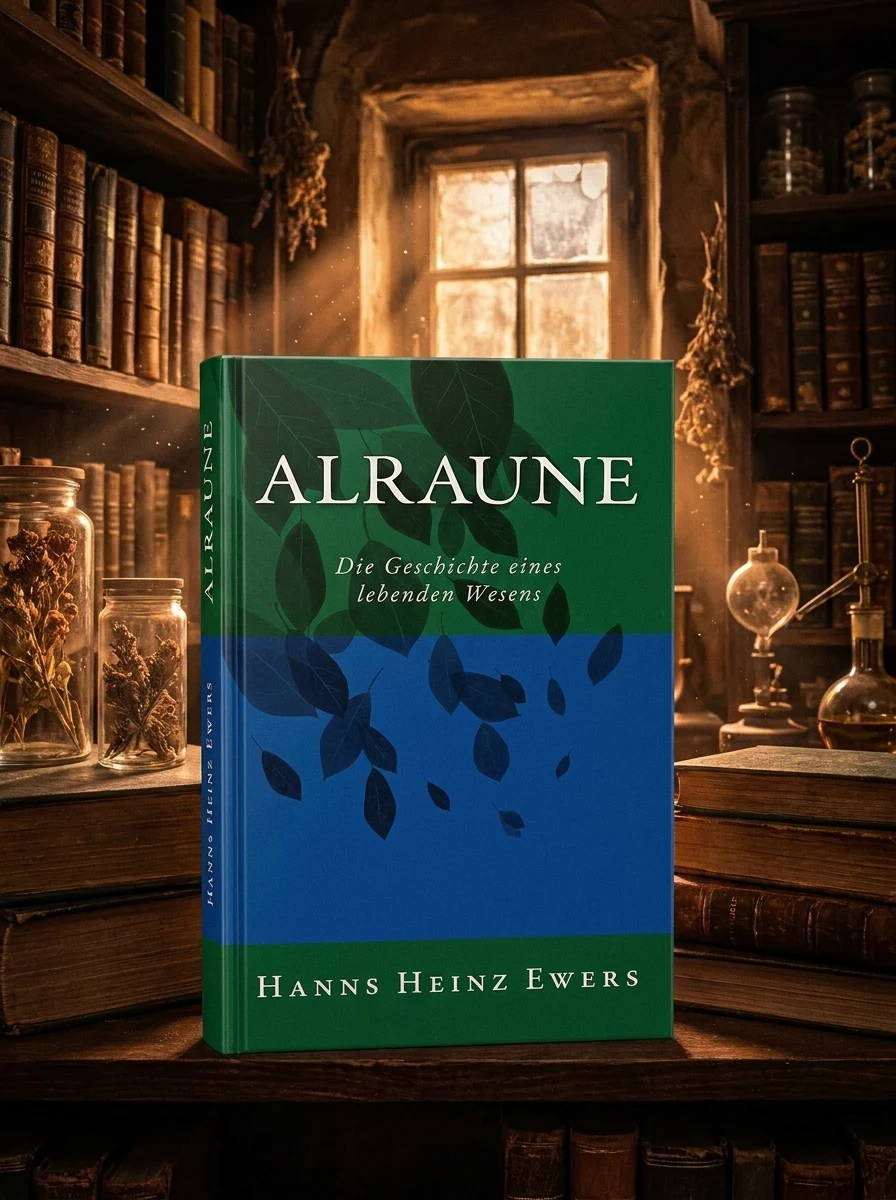
Alraune: Die Geschichte eines lebenden Wesens
A restored 1911 novel about a woman created from a prostitute and a murderer.
The story centers on Alraune, a character whose existence is rooted in the myth of the mandrake root. Ewers uses this legend to explore themes of nature versus nurture within a psychological framework. The narrative examines how her origins as the child of a sex worker and a killer influence her development and actions. This approach aligns with Ewers' broader interest in the intersection of art, eroticism, and the exotic. The work gained massive popularity in its early years, becoming a cultural touchstone that transcended literature to influence film and radio media decades later.
Hanns Heinz Ewers published this work in Germany during the Weimar Republic era. The 1911 edition reflects early twentieth-century anxieties about heredity and morality. It stands as a key text in German Expressionism, bridging print literature and emerging visual media like film.


📝 Description: Alraune: Die Geschichte eines lebenden Wesens
💎 Our verdict on Alraune: Die Geschichte eines lebenden Wesens
📖 Why choose it
Why this book is worth reading
This volume is essential for scholars and enthusiasts of early twentieth-century gothic fiction who wish to understand the historical roots of horror cinema adaptations. Readers interested in the intersection of art, eroticism, and exoticism will find Ewers’ dramatic depictions compelling, as they reflect his broader cultural impact. The text serves as a fascinating case study in biological determinism and psychological horror, offering insight into how early 1900s writers utilized folklore to explore complex human behaviors. It appeals to those who appreciate the evolution of vampire and monster myths beyond simple supernatural scares, looking instead at the sociological and scientific anxieties of the era that shaped modern genre conventions.
⭐ Reader reviews
Reader rating
Ewers constructs a provocative narrative by grounding his fantastical premise in a specific biological hypothesis, utilizing the mandrake myth to examine how origins dictate destiny. The restoration offers excellent resolution and includes six illustrations that enhance the atmospheric tension typical of German Expressionism. While the reliance on biological determinism may unsettle some modern sensibilities, the book succeeds as a dense psychological framework for horror. It is best suited for readers comfortable with explicit subject matter and those interested in the historical context of horror media. The work remains a vital cultural touchstone, demonstrating how literature influenced subsequent film and radio adaptations while maintaining its status as a scandalous bestseller of its time.
📖 Read on the blog
✍️ More books by this author Hanns Heinz Ewers






You might also like
See more →



Have a question about this item?
Ask about the edition, condition, delivery or anything else — we reply by email or phone, usually within a day.
