
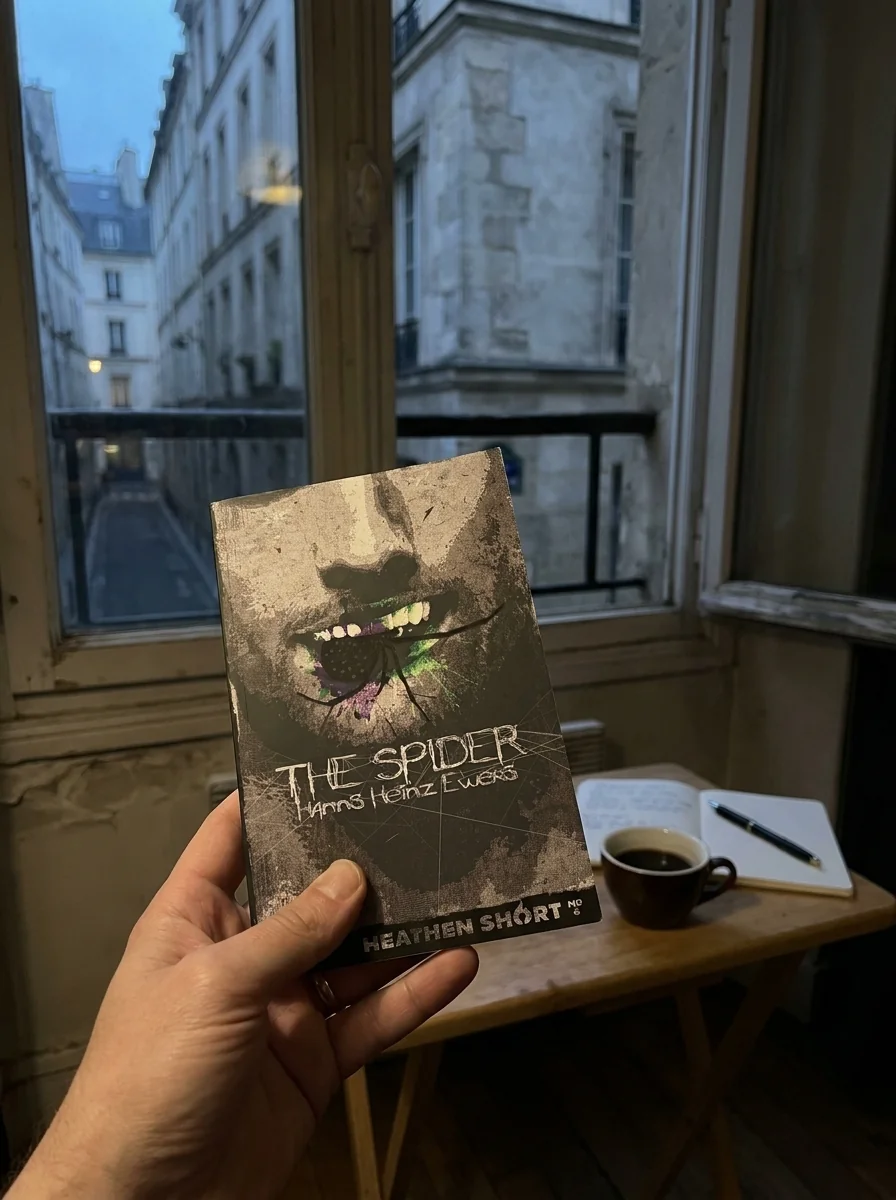

The Spider (Heathen Short)
A journal detailing a medical student's psychological unraveling in Paris.
This short story captures the moment when rationality fails against the unknown. The protagonist, a medical student, witnesses strange events in his Parisian hotel. A silent woman across the street becomes the focal point of his growing obsession. The narrative tracks his shift from clinical observer to trapped participant. Ewers uses the journal format to show this decay in real time. The horror lies in the quiet acceptance of his fate. There are no jump scares or violent confrontations. Instead, the terror builds through repetition and symmetry. The story ends with the complete dissolution of the self into the web.
Hanns Heinz Ewers wrote this in 1908, placing it firmly in the early twentieth-century German decadent horror tradition. The story reflects the occult provocateur's interest in psychological decay and supernatural entrapment within urban European settings.


📝 Description: The Spider (Heathen Short)
💎 Our verdict on The Spider (Heathen Short)
📖 Why choose it
Why this book is worth reading
Readers who appreciate slow-burning atmospheric tension and psychological horror will find this text rewarding. It appeals to those interested in the fragility of the human mind and the dissolution of rationality. The journal format offers an intimate look at internal collapse, making it ideal for fans of early twentieth-century European literature. Those seeking clear resolutions or fast-paced action may struggle with its quiet, repetitive dread. However, lovers of gothic fiction and supernatural themes will value its stark examination of compulsive entrapment. It is best suited for individuals who enjoy metaphysical webs tightening around their subjects without noise or violence.
⭐ Reader reviews
Reader rating
Ewers crafts a haunting exploration of psychological decay through the lens of a medical student in Paris. The narrative excels in building terror via silence and symmetry rather than jump scares. By using a journal format, the text immerses readers in the protagonist's gradual obsession with a silent woman across the street. The horror lies in the quiet acceptance of fate and the boundary dissolving between watcher and watched. This approach suits fans of psychological horror and early European gothic fiction. Those preferring external monsters or clear resolutions may find the slow descent difficult. Yet, for readers valuing atmospheric tension and metaphysical entrapment, this work offers a stark, compelling look at the mind's fragility under unseen forces.
📖 Read on the blog
✍️ More books by this author Hanns Heinz Ewers



🏛 Books from this publisher Heathen Shorts


You might also like
See more →Have a question about this item?
Ask about the edition, condition, delivery or anything else — we reply by email or phone, usually within a day.
