🩸Horror Tradition
Wraith
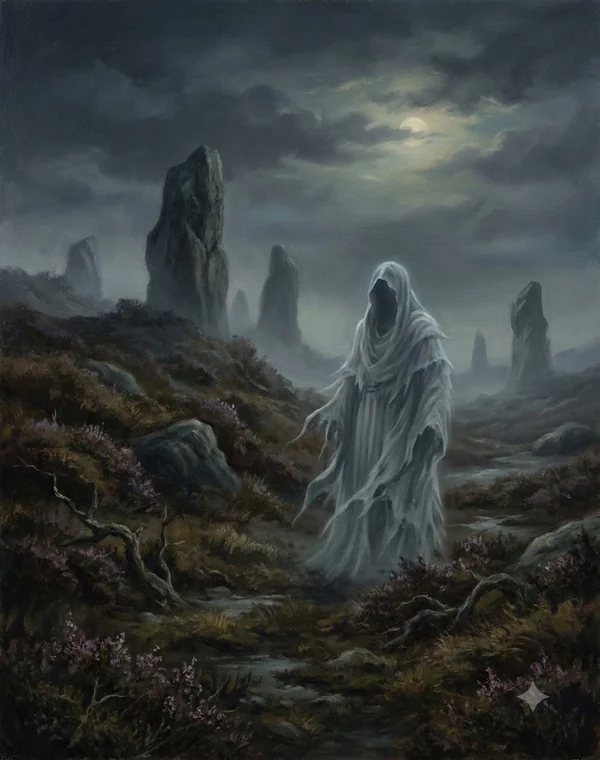
A wraith is a ghostly apparition or double of a living person, originating primarily in Scottish folklore and early modern British regional traditions as a terrifying omen of impending death.
Etymology & Origin
Where the word comes from
First appearing in Scottish texts during the 1510s, the word wraith is of uncertain origin, though some historical dictionaries suggest a connection to Old Norse terms for guardian spirits or Gaelic words for specters.
Full Definition
In depth
Origins In Scottish tradition and broader British folklore, the legend of the wraith emerged strongly by the early sixteenth century. While precise linguistic roots remain debated, the concept aligns closely with northern European beliefs concerning spectral doubles, guardian spirits, and death fetches. Unlike standard disembodied ghosts bound to ancient gravesides, the traditional wraith belonged specifically to the living lore of families and local communities, functioning as an eerie folkloric double that bridged the gap between everyday existence and the finality of mortality.
What It Is Said to Do According to regional folklore, a wraith manifests as an exact, silent visual duplicate of a living person, appearing to friends, family members, or the individual themselves shortly before death. It is typically described as pale, insubstantial, or shadowy, mirroring the exact clothing and posture of the person it mimics. Folklore dictates that seeing one's own wraith is an infallible death omen. Because these entities are incorporeal projections rather than physical attackers, traditional apotropaic charms offer little defense; their primary power lies in the psychological dread and despair they instill upon realization.
In Horror Fiction In horror literature, writers have adapted the traditional wraith into a symbol of psychological disintegration, inescapable fate, and the haunting presence of past trauma. Gothic and supernatural fiction frequently use the motif to explore themes of duality, where the apparition externalizes a character's hidden guilt or impending doom. Authors have utilized these spectral doubles to evoke a creeping sense of fatalism and existential isolation, transforming the folklore into a chilling narrative device where human identity fractures under the weight of the supernatural.
Why It Still Frightens The wraith endures as a source of terror because it targets our deepest fear of alienation and self-recognition, confronting us with the terrifying prospect of our own mortality looking back from the void.
Connected Concepts
Related horror terms
Further Study