🩸Horror Tradition
Black Annis
Black Annis is a fearsome, blue-faced hag and bogeyman figure originating from English folklore, traditionally said to haunt a cave in the Dane Hills of Leicestershire.
Etymology & Origin
Where the word comes from
The name likely derives from a combination of her dark appearance and variants like "Cat Anna" or references to ancient deities, though its exact linguistic roots remain debated.
Full Definition
In depth
Origins Black Annis is rooted in the regional oral traditions and folklore of Leicestershire, England, particularly associated with the Dane Hills. While local legends paint her as an ancient fixture of the landscape, the figure crystallized in written record and poetry during the late 18th century, notably in a 1797 poem by John Heyrick. Some folklorists and antiquarians have theorized that the legend may derive from earlier pagan deities, such as the Celtic mother goddess Danu or Anu, while other local hypotheses suggest she could be a distorted folk memory of a medieval anchoress or recluse living in isolation. Over centuries, her persona shifted from a vague territorial spirit into a vivid, malicious bogeyman utilized by adults to enforce community boundaries.
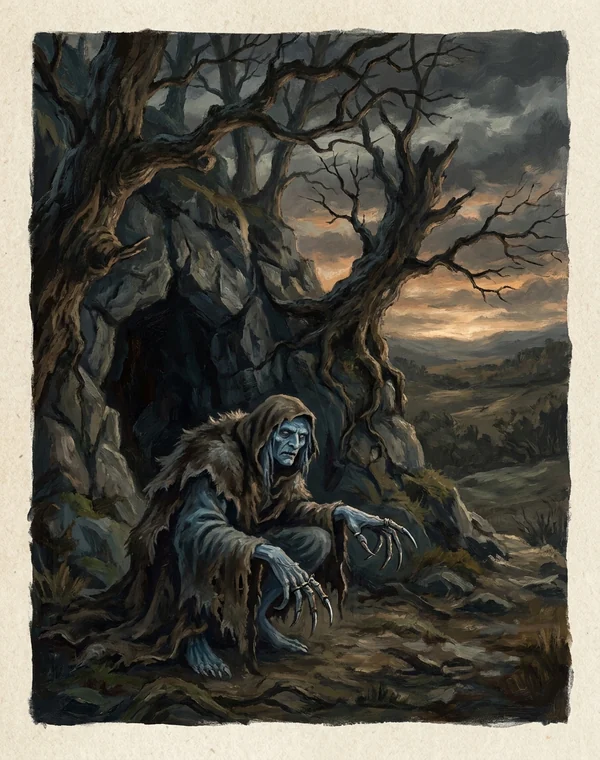
What It Is Said to Do In traditional accounts, Black Annis is imagined as a gaunt, hideous hag possessing a livid blue face and long, iron-like talons in place of human hands. She is said to dwell within a subterranean cave system scooped out of the earth beneath the Dane Hills, with some tales claiming an underground tunnel connected her lair directly to Leicester Castle. She was widely feared as a nocturnal hunter who preyed upon unwary children, lambs, and travelers, wearing the skins of her victims around her waist. To protect themselves, local villagers were said to construct cottages with intentionally tiny windows to prevent her long arms from reaching inside, relying on daylight to neutralize her powers.
In Horror Fiction Within horror fiction and modern weird tales, Black Annis serves as an embodiment of primeval British folk terror, representing the dread of untamed wilderness and predatory isolation. Authors and independent writers drawing on folk horror tropes utilize her legend to explore themes of localized paranoia, historical trauma, and the thin veil separating civilized settlements from ancient, blood-soaked landscapes. The imagery of her iron talons, blue skin, and subterranean confinement provides a rich template for modern psychological and supernatural horror narratives that probe deep into rural folklore.
Why It Still Frightens Black Annis endures because she taps into the universal childhood dread of the dark and the primal fear of monsters lurking just beyond the safety of the hearth.
Connected Concepts
Related horror terms
Further Study