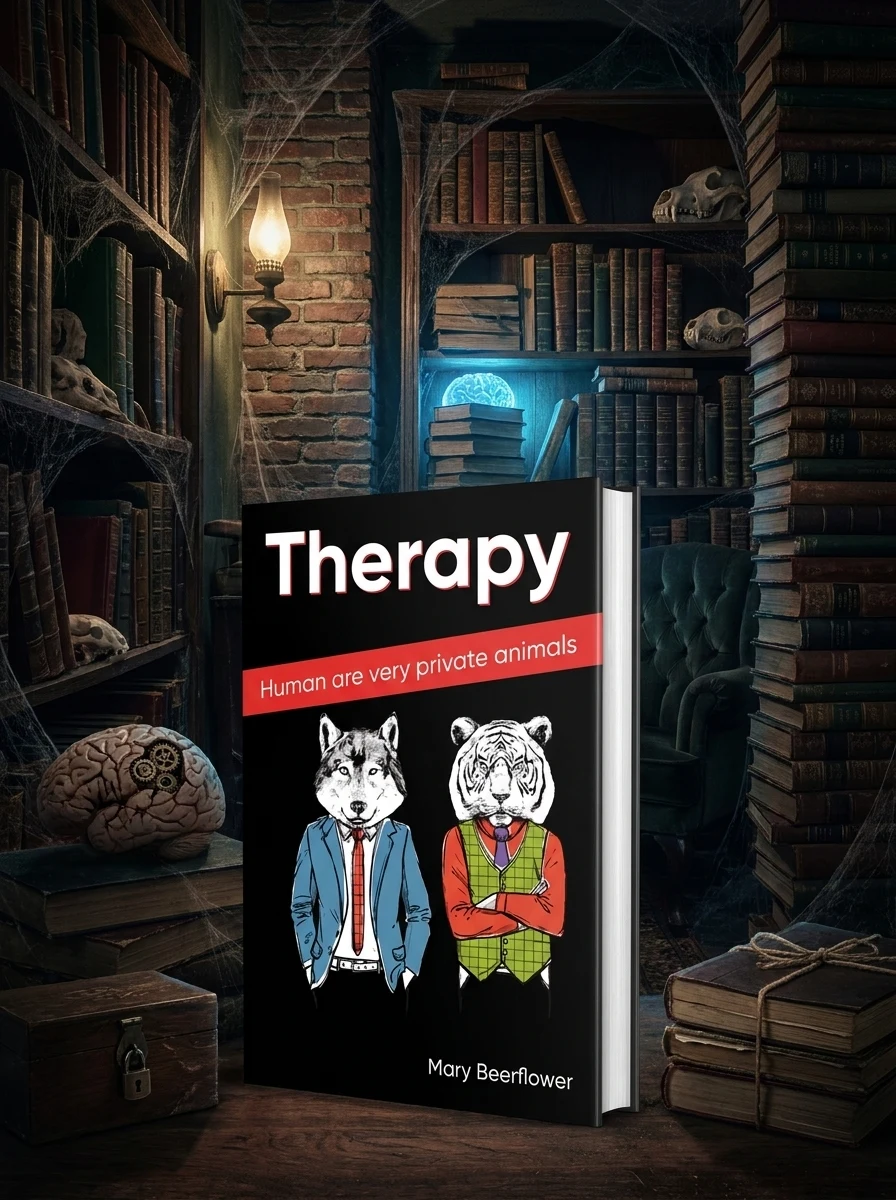

The Therapy: humans are very private animals
A philosophical examination of privacy as a defense mechanism against power.
Beerflower frames privacy not as a natural instinct but as a calculated social response to the threat of losing power. She compares the protective function of mental filters to architectural walls, suggesting both serve to keep knowledge away from potential adversaries. The core argument rests on the idea that revealing truth is an act of surrendering control. This loss of agency can force individuals into actions they would otherwise avoid. The book treats privacy as a defensive wall against the vulnerability inherent in trust.
Published independently in late 2020, this title enters the market without traditional academic backing. It reflects a contemporary interest in personal boundaries and psychological autonomy. The work stands apart from clinical literature by focusing on philosophical implications rather than therapeutic techniques.


📝 Description: The Therapy: humans are very private animals
💎 Our verdict on The Therapy: humans are very private animals
📖 Why choose it
Why this book is worth reading
Readers fascinated by the intersection of psychology and social theory will find value in this conceptual framework. Those interested in analyzing power dynamics within relationships may appreciate Beerflower’s argument that privacy is a calculated strategy rather than an instinct. It suits individuals who enjoy abstract discussions on vulnerability and control without the distraction of practical advice or empirical data. The book offers a unique lens for understanding the fear of exposure, appealing to those who view truth as a surrender of agency rather than a liberation. It is ideal for readers seeking a philosophical examination of how we guard our inner worlds against external observation.
⭐ Reader reviews
Reader rating
Beerflower presents a compelling, albeit abstract, argument that privacy serves as a defensive wall against the vulnerability inherent in trust. The text excels in framing mental filters as architectural defenses, effectively illustrating the tension between revealing truth and maintaining control. While it lacks scientific data or narrative plot, its strength lies in its conceptual rigor regarding power dynamics. This work is best suited for readers who enjoy theoretical horror and psychological analysis over traditional storytelling. It offers a dense, philosophical exploration of secrecy that rewards careful attention to its core thesis about the cost of exposure.
📖 Read on the blog
🏛 Books from this publisher Independently Published








You might also like
See more →





Have a question about this item?
Ask about the edition, condition, delivery or anything else — we reply by email or phone, usually within a day.
