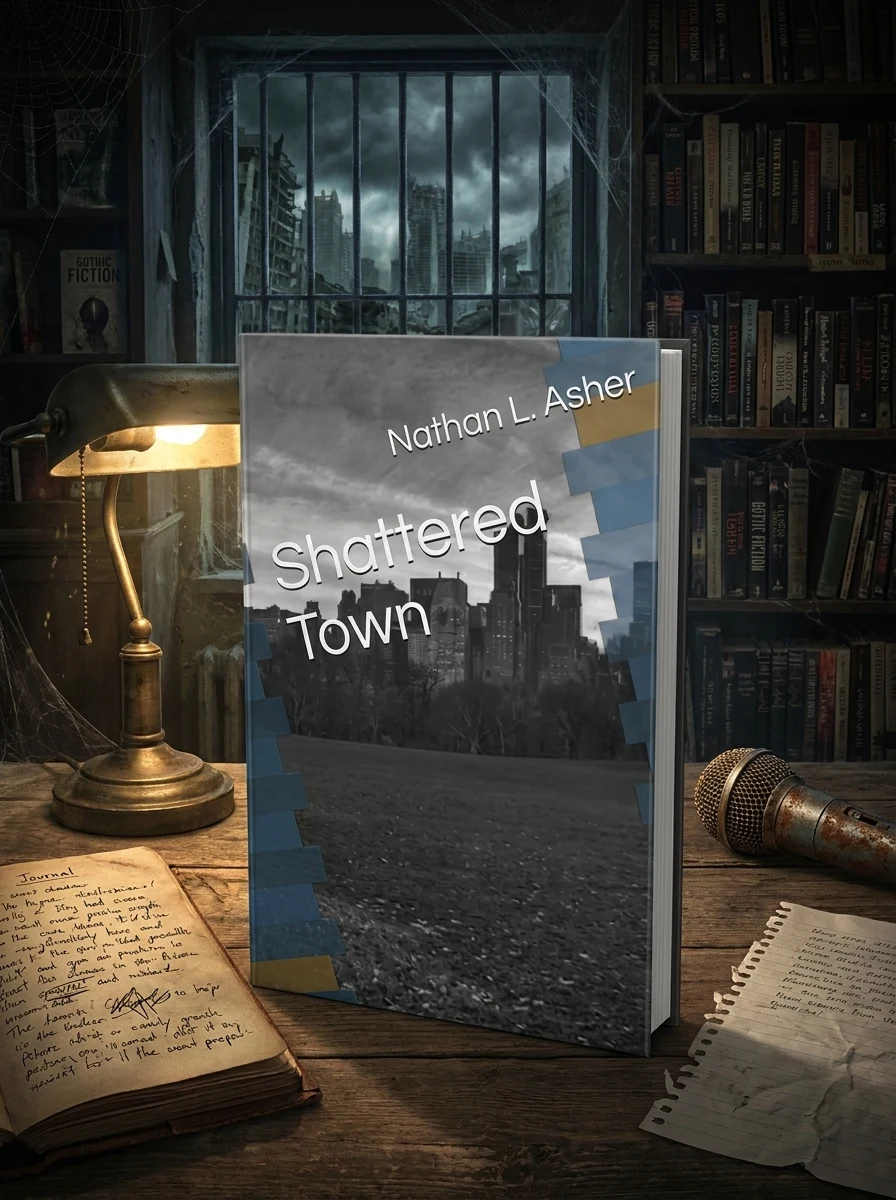

Shattered Town
A madman's journal reveals horrors in a shattered town during an interrogation.
The narrative focuses on the psychological deterioration of two men trapped in a single room. Daniel Patterson prepares to question a prisoner who claims madness. The prisoner produces a journal that appeared without explanation. This text details his return to a place of chaos and his efforts to correct past mistakes. The horrors described are abstract and mental rather than physical monsters. The structure relies on the tension between the interrogator's skepticism and the narrator's deteriorating grip on reality. Asher uses this confined setting to explore themes of guilt and insanity without providing easy answers or heroic victories.
This 2021 independent publication fits within the modern tradition of American psychological horror. It echoes gothic conventions by focusing on internal decay and confinement. The work reflects contemporary interest in fragmented narratives and mental health struggles.


📝 Description: Shattered Town
💎 Our verdict on Shattered Town
📖 Why choose it
Why this book is worth reading
Readers who appreciate slow-burn psychological terror and the disorientation of unreliable narrators will find this book compelling. It offers a claustrophobic descent into madness without relying on external action or clear resolutions. Those seeking to explore themes of guilt, insanity, and despair through an abstract, mental lens will gain from its intense focus on internal unraveling. The narrative provides no comfort or escape, appealing specifically to those who enjoy lingering unease over closure.
⭐ Reader reviews
Reader rating
Asher crafts a tense atmosphere confined entirely within an interrogation room and the narrator's memories. The structure effectively mimics erratic thoughts, blurring reality and delusion for a deeply unsettling experience. While it lacks action sequences, its strength lies in the psychological deterioration of both characters. This book suits readers who enjoy abstract horrors and ambiguous endings. It avoids easy answers or heroic victories, leaving the audience with a profound sense of despair. The confined setting enhances the claustrophobic tone, making it a potent study of mental collapse rather than a conventional thriller.
📖 Read on the blog
🏛 Books from this publisher Independently Published








You might also like
See more →
Have a question about this item?
Ask about the edition, condition, delivery or anything else — we reply by email or phone, usually within a day.
