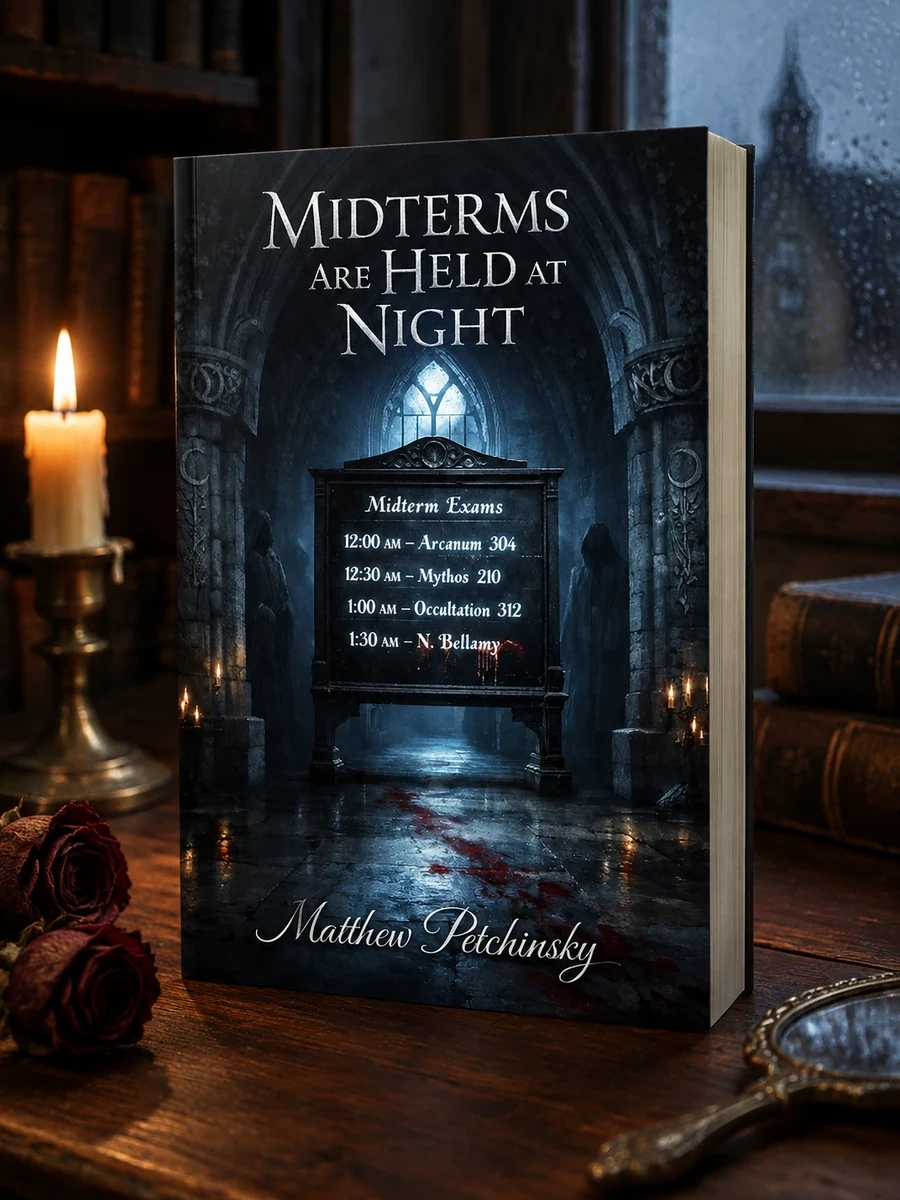
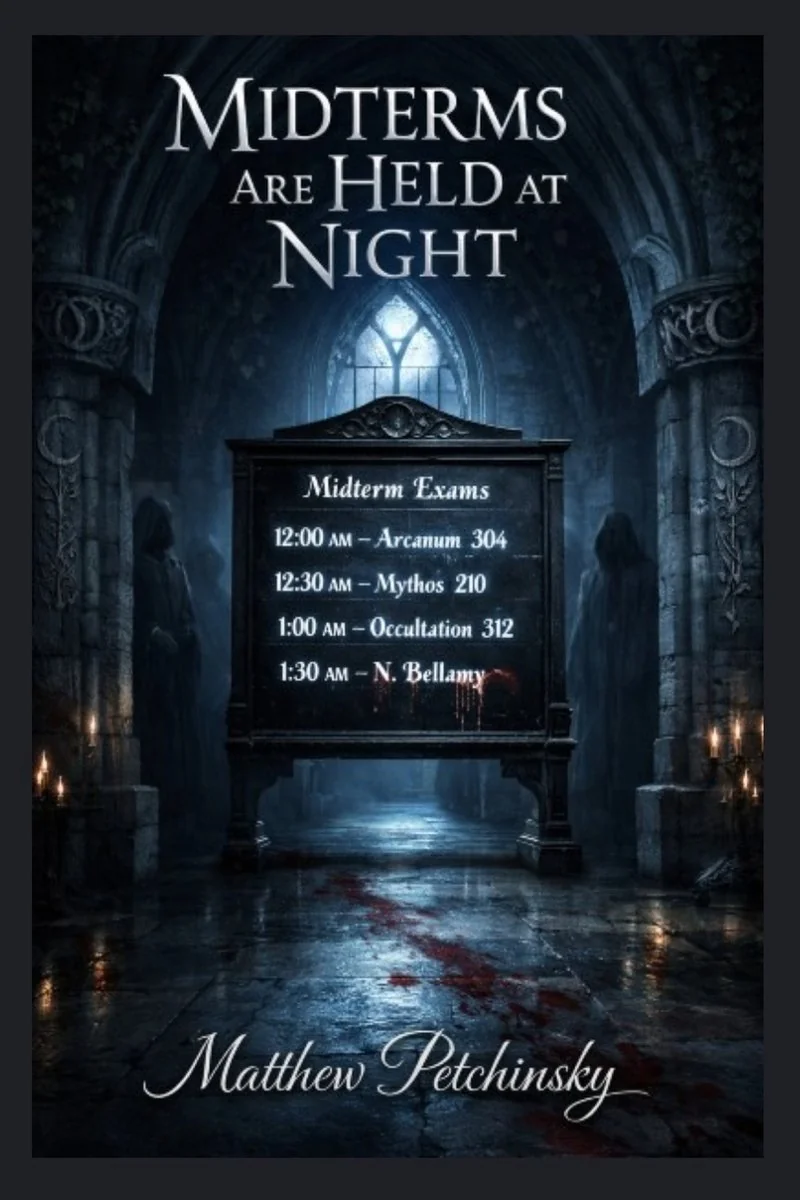
Midterms Are Held at Night
A gothic horror novel about a university exam system that feeds on fear after dark.
Elias Varn and Lenora Vale uncover a secret academic ritual at Blackthorn University. This hidden system operates exclusively at night, utilizing proctors without faces to administer exams in the absence of classrooms or professors. The narrative focuses on their descent into the institution's understructure, where they face questions that impact the soul directly. Petchinsky uses this setting to explore how memory and fear are commodified by ancient powers. The story emphasizes the psychological toll of defiance against an unyielding system. Readers follow the protagonists as reality fractures around them, forcing a confrontation with the cost of survival. The plot avoids conventional academic structures, replacing them with a supernatural ordeal that tests the limits of human endurance and love.
This novel sits within the American gothic horror tradition, published by Apophis Enterprises LLC in 2026. It draws on supernatural fiction tropes to examine institutional power and psychological dread. The work engages with contemporary anxieties about academic pressure and systemic control through a lens of magical realism and horror.


📝 Description: Midterms Are Held at Night
💎 Our verdict on Midterms Are Held at Night
📖 Why choose it
Why this book is worth reading
Readers who appreciate atmospheric horror and psychological tension will find this novel compelling. It suits those interested in academic settings twisted by supernatural threats, offering a deep dive into how memory and fear are commodified. The story appeals to fans of gothic fiction who enjoy exploring the erosion of reality and the psychological toll of defiance against unyielding systems. It is ideal for individuals seeking an oppressive tone that prioritizes intellectual dread over conventional jump scares.
⭐ Reader reviews
Reader rating
Petchinsky crafts a compelling narrative where Blackthorn University becomes a vessel for ancient, fear-feeding powers. The depiction of faceless proctors and soul-carving questions creates a unique sense of unease. By replacing traditional academic structures with supernatural ordeals, the author highlights the cost of survival and the fragility of human endurance. The focus on love and memory adds emotional weight to the cosmic horror elements. While the tone is undeniably oppressive, it effectively serves the genre's goal of inducing psychological dread. It stands as a strong entry in modern gothic horror for those willing to engage with its challenging thematic depth.