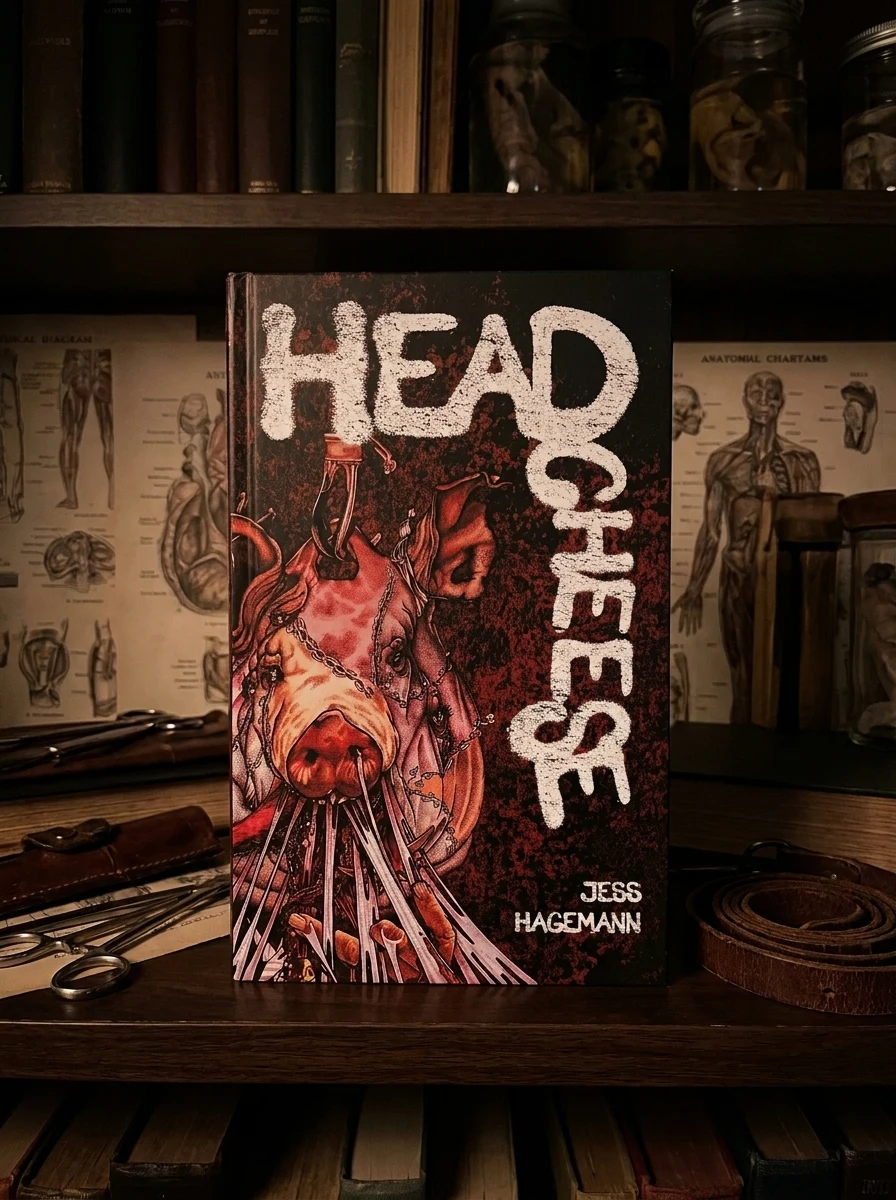
Headcheese
A novel exploring twenty-six people with Body Integrity Identity Disorder.
Hagemann presents a collection of vignettes focusing on individuals who wish to alter or remove parts of their bodies. Lorrie discovers a desire for able-bodiedness after an accidental toe loss. Bartholomew creates a church where amputation and sex function as performance art. Trice faces the challenge of rebuilding his son’s crippled frame as a prosthetics engineer. George deals with grief by attempting to permanently remove his wife’s ghost. These narratives examine the complex relationship between physical form and mental identity. The author uses her experience as a biographer to ground these fantastical elements in realistic psychological detail. The work avoids sensationalism, instead offering a clinical yet intimate view of those navigating the boundaries of flesh and self.
Published in 2022 by Encyclopocalypse Publications, this novel sits within the horror and gothic fiction traditions. Hagemann lives in Austin, Texas, a setting that contrasts with the dark subject matter of her debut work exploring bodily autonomy and supernatural grief.


📝 Description: Headcheese
💎 Our verdict on Headcheese
📖 Why choose it
Why this book is worth reading
This book is ideal for readers who appreciate clinical diagnoses and the complex psychology of bodily autonomy. It offers a stark, intimate look at individuals navigating their physical identities without romanticizing their conditions. Those interested in the intersection of medical reality and personal desire will find value in its realistic portrayal of psychological states. The text avoids traditional horror thrills, instead providing a grounded examination of those who do not want their own bodies. Readers seeking uplifting narratives may find it unsettling, but those drawn to dark fantasy and true crime adjacent themes will appreciate its unflinching gaze into the topography of flesh.
⭐ Reader reviews
Reader rating
Jess Hagemann delivers a striking collection of vignettes that peel back the epidermis to reveal the topography of flesh. By examining characters like Lorrie and Bartholomew, she grounds fantastical elements in realistic psychological detail. The narrative avoids sensationalism, offering instead a clinical yet intimate view of bodily autonomy. This approach suits readers interested in the psychology of identity and the gothic tradition of exploring minds that reject their physical forms. While it lacks traditional comfort or supernatural scares, its strength lies in its unflinching realism. The work stands as a significant contribution to psychological horror, challenging readers to confront the disquieting realities of those who wish to alter or remove parts of themselves.
📖 Read on the blog
✍️ More books by this author Jess Hagemann



🏛 Books from this publisher Encyclopocalypse Publications




You might also like
See more →



Have a question about this item?
Ask about the edition, condition, delivery or anything else — we reply by email or phone, usually within a day.
