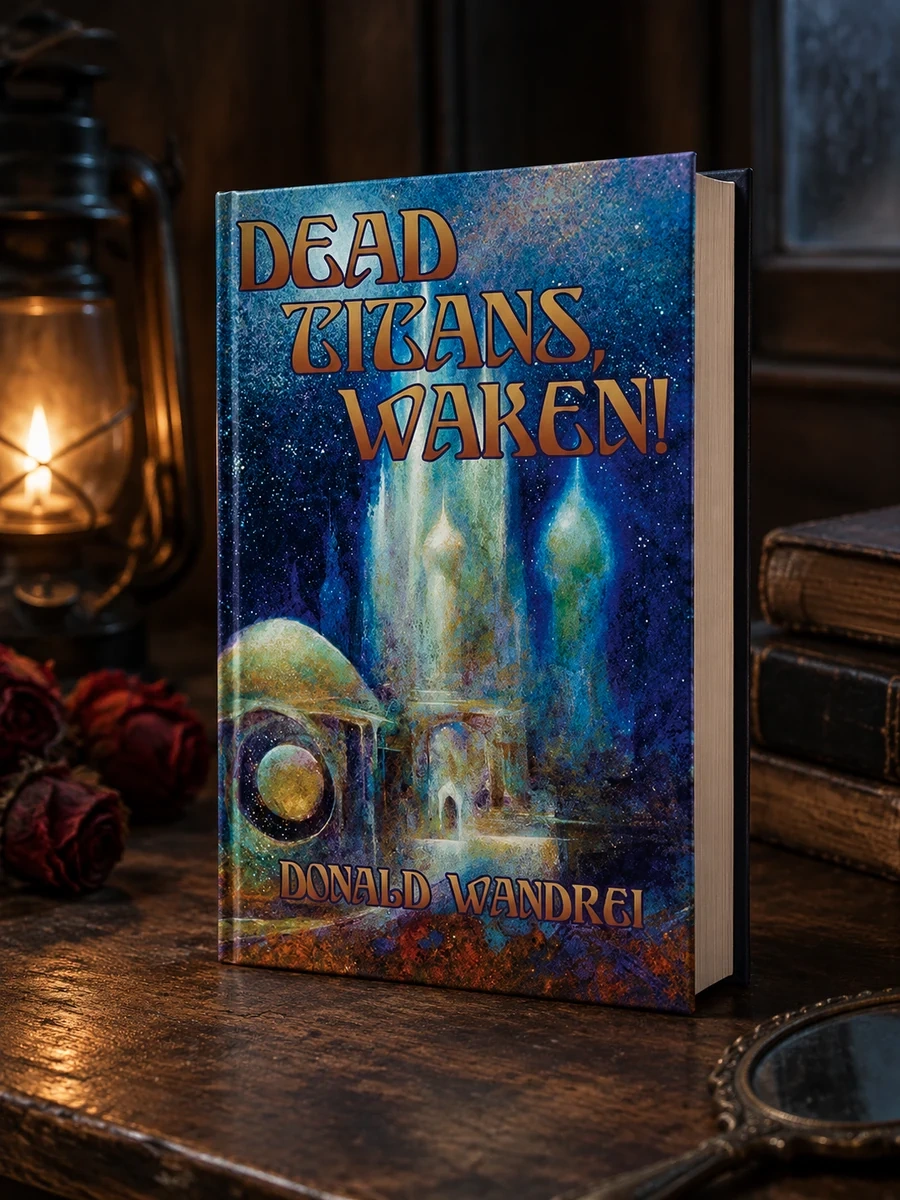

Dead Titans, Waken!
A collection of two novels by Donald Wandrei, including an early Mythos work and a posthumous psychological horror story.
Donald Wandrei contributed significantly to early weird fiction as part of the Lovecraft Circle. This edition gathers his novel Dead Titans, Waken!, which Arkham House later republished as The Web of Easter Island. It represents a foundational text for fans of that specific mythos. The companion piece, Invisible Sun, remained hidden until now. Its delay in publication highlights its intense nature. S.T. Joshi’s notes clarify the context of these disparate works. One belongs to a well-defined genre tradition, while the other explores darker, more personal fears. This juxtaposition allows readers to see Wandrei’s range. It covers both the external cosmic threats and internal psychological dread that defined his career.
Donald Wandrei wrote these works during the pulp era, aligning him with the Lovecraft Circle. Dead Titans connects to Arkham House publications, while Invisible Sun reflects the suppressed content of the 1930s, remaining unpublished until Fedogan and Bremer released it in 2017.


📝 Description: Dead Titans, Waken!
💎 Our verdict on Dead Titans, Waken!
📖 Why choose it
Why this book is worth reading
Readers deeply invested in the origins of cosmic horror or the lesser-known contributions of the Lovecraft Circle will find this collection invaluable for understanding Wandrei's range. It specifically suits those who appreciate the transition from standard pulp fiction to more complex, internal psychological narratives. Those seeking only mainstream contemporary horror may find the vintage style and specific Mythos references less appealing, but scholars and fans of foundational weird fiction will gain significant insight into how external cosmic threats were juxtaposed with intense, personal fears in early 20th-century literature.
⭐ Reader reviews
Reader rating
Wandrei’s dual offering provides a fascinating glimpse into his literary range. Dead Titans, Waken! remains a foundational text for Mythos enthusiasts, establishing its place within that specific tradition through its original form before Arkham House republished it. Conversely, Invisible Sun offers a stark contrast as an intense, raw psychological horror story that was too daring for its time. S.T. Joshi’s contextual notes are essential for appreciating the historical significance of these disparate works. The volume succeeds by allowing readers to witness the shift from external cosmic dread to internal psychological terror, making it a compelling study for those interested in the development of weird fiction and the diverse capabilities of Lovecraft Circle members.