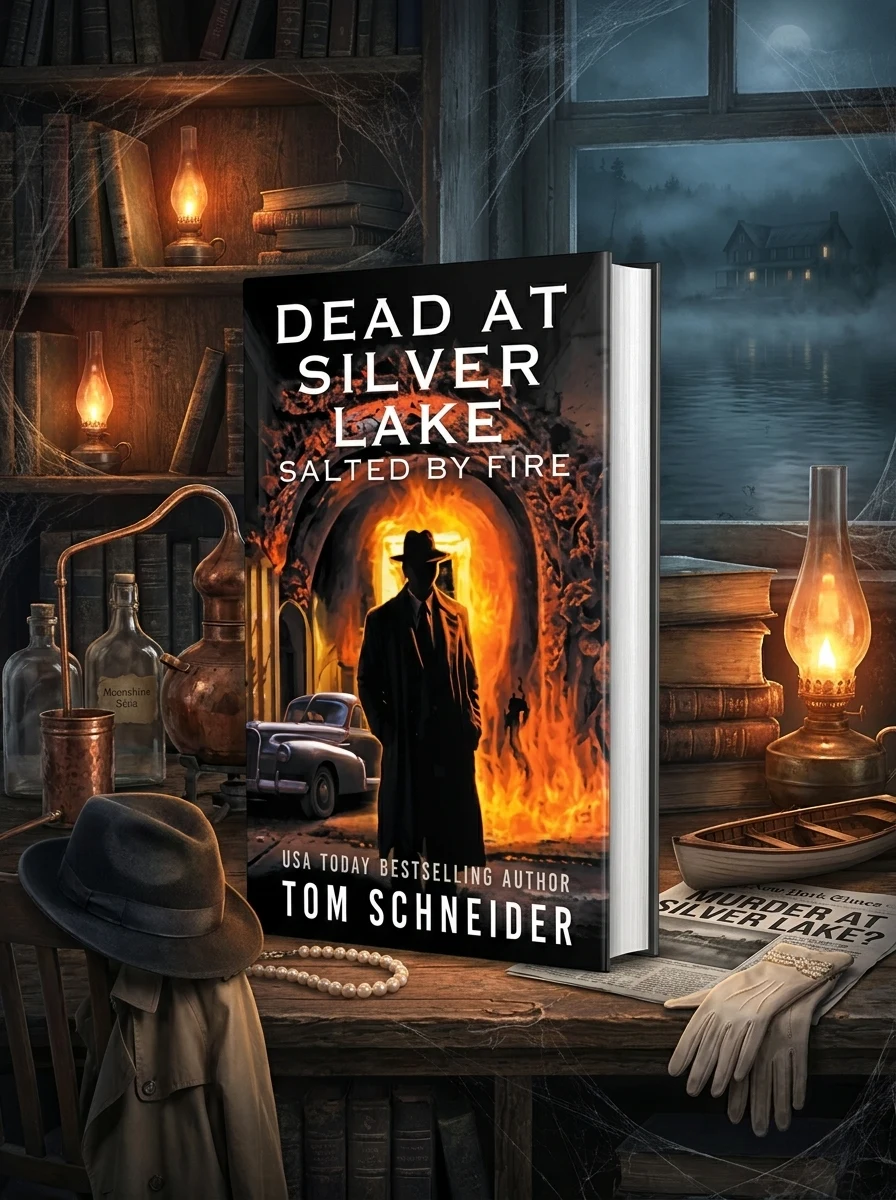
Dead at Silver Lake
A moonshiner investigates a murder that blurs the line between life and death in 1930s America.
Teddy enters the elegant world of The Silver Lake Inn after seeing a murder at the lake. He falls for Hildegard while chasing the truth about the victim who returns from the dead. The murderer recruits him into a dark path. Schneider writes this as a cautionary tale about the cost of ambition and curiosity during prohibition. The story focuses on Teddy’s internal struggle between desire and survival. It avoids romanticizing the criminal underworld, instead showing its corrosive effect on the soul.
The book is set in the last days of prohibition in the United States. It draws on the historical period’s tension between legal boundaries and underground activities. The setting includes rural landscapes like Silver Lake and social spaces such as The Silver Lake Inn, reflecting the era's class divides.


📝 Description: Dead at Silver Lake
💎 Our verdict on Dead at Silver Lake
📖 Why choose it
Why this book is worth reading
Readers drawn to atmospheric tales that blend historical settings with psychological and gothic horror will find this book compelling. It offers a nuanced exploration of moral compromise and spiritual loss, avoiding the romanticization of the criminal underworld to instead highlight its corrosive effect on the soul. Those interested in stories where ambition and curiosity carry a heavy price will appreciate the cautionary tone. The narrative focuses on internal struggle rather than exposition, making it ideal for fans who prefer character-driven tension over fast-paced action or non-fiction historical accounts. It provides a grim, unresolved conclusion that defines its dark mood.
⭐ Reader reviews
Reader rating
Tom Schneider crafts a supernatural mystery that effectively merges the prohibition era with gothic horror elements. The narrative structure relies heavily on character interaction to build tension, avoiding excessive exposition while maintaining a gripping pace. By focusing on Teddy’s internal battle between desire and survival, the text achieves a profound sense of dread without resorting to cheap scares. The work succeeds in depicting the corrosive nature of ambition, offering a stark warning rather than an exciting adventure. It is best suited for readers who appreciate slow-burn psychological horror and atmospheric storytelling over action-heavy plots or historical non-fiction.
You might also like
See more →







Have a question about this item?
Ask about the edition, condition, delivery or anything else — we reply by email or phone, usually within a day.
