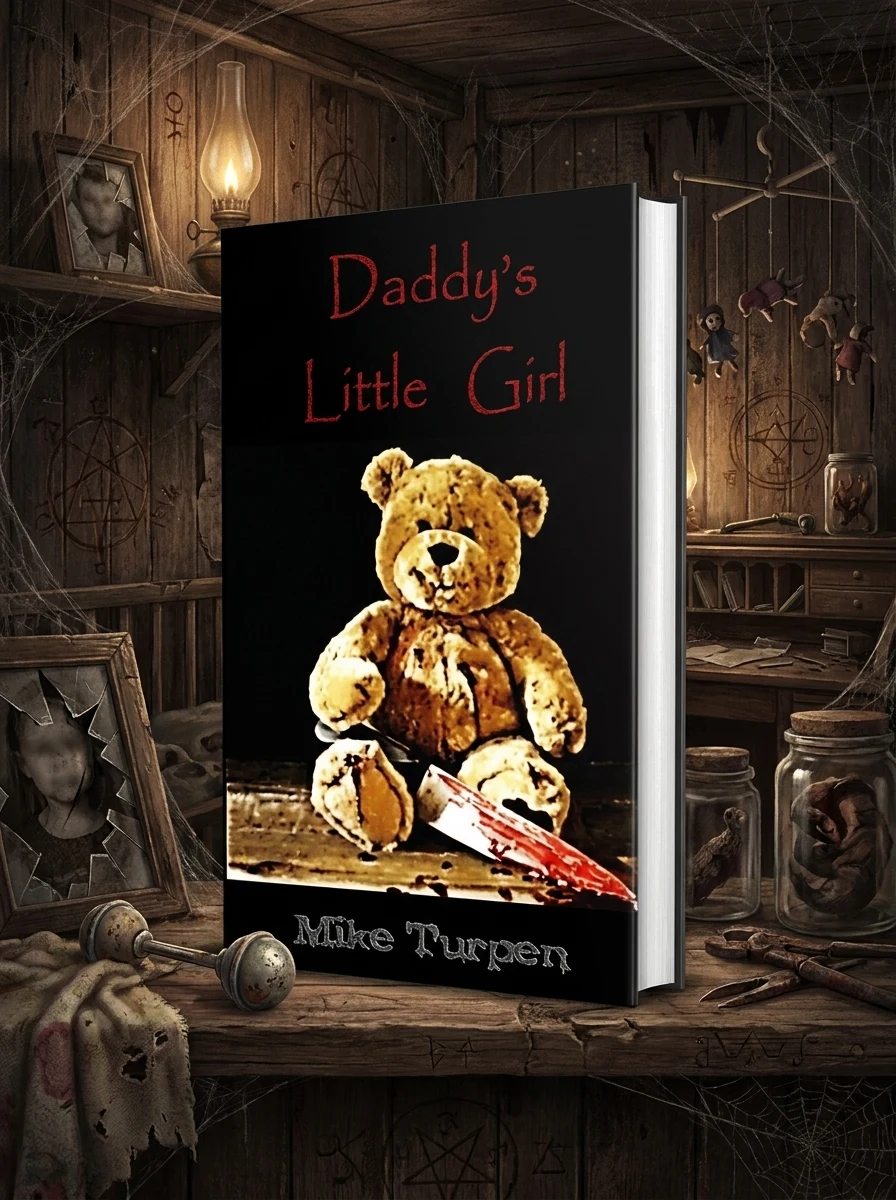

Daddy's Little Girl
A father blames his newborn for his wife's death, creating a monster in her place.
The narrative focuses on Harrison Kringe's mental collapse following the death of his wife during childbirth. He directs his rage toward his infant daughter, viewing her as the cause of his suffering. This perspective leads him to raise her in an environment defined by fear and horror. The text examines how this twisted upbringing shapes the child into a creature of violence. Turpen uses this premise to explore themes of blame and distorted parenting. The story does not rely on external threats but rather on the internal decay of the protagonist's mind. Readers interested in the psychological aspects of grief and its potential for extreme outcomes will find this compelling. The work avoids conventional horror tropes by focusing on domestic tragedy.
This 2015 independent publication sits within the modern tradition of psychological horror fiction. It reflects contemporary interests in family trauma and the supernatural elements of grief. The work emerges from the era of independent publishing platforms, allowing for niche themes to reach audiences without major commercial constraints.


📝 Description: Daddy's Little Girl
💎 Our verdict on Daddy's Little Girl
📖 Why choose it
Why this book is worth reading
Readers who appreciate character-driven psychological terror and the exploration of dark family dynamics will find this narrative compelling. It offers a deep examination of grief's destructive power, showing how parental love can warp into something monstrous. Those interested in the internal decay of the protagonist rather than external threats will gain insight into the extreme outcomes of unchecked rage and blame. The book provides a unique perspective on distorted parenting, suitable for those who enjoy tension built through gradual revelation rather than fast-paced action or traditional jump scares.
⭐ Reader reviews
Reader rating
Turpen crafts a chilling study of mental collapse, grounding horror in emotional realism rather than conventional tropes. By focusing on the isolated domestic sphere, he effectively illustrates how grief can fracture sanity and create a monster from within the family unit. The narrative successfully avoids external threats, relying instead on the terrifying dynamic between a fractured father and his victimized daughter. This approach suits readers who prefer slow-burning psychological dread over action-oriented plots. The exploration of blame and distorted upbringing is handled with a grim precision that highlights the fragility of the human mind under extreme duress.
📖 Read on the blog
🏛 Books from this publisher Createspace Independent Publishing Platform







You might also like
See more →





Have a question about this item?
Ask about the edition, condition, delivery or anything else — we reply by email or phone, usually within a day.
