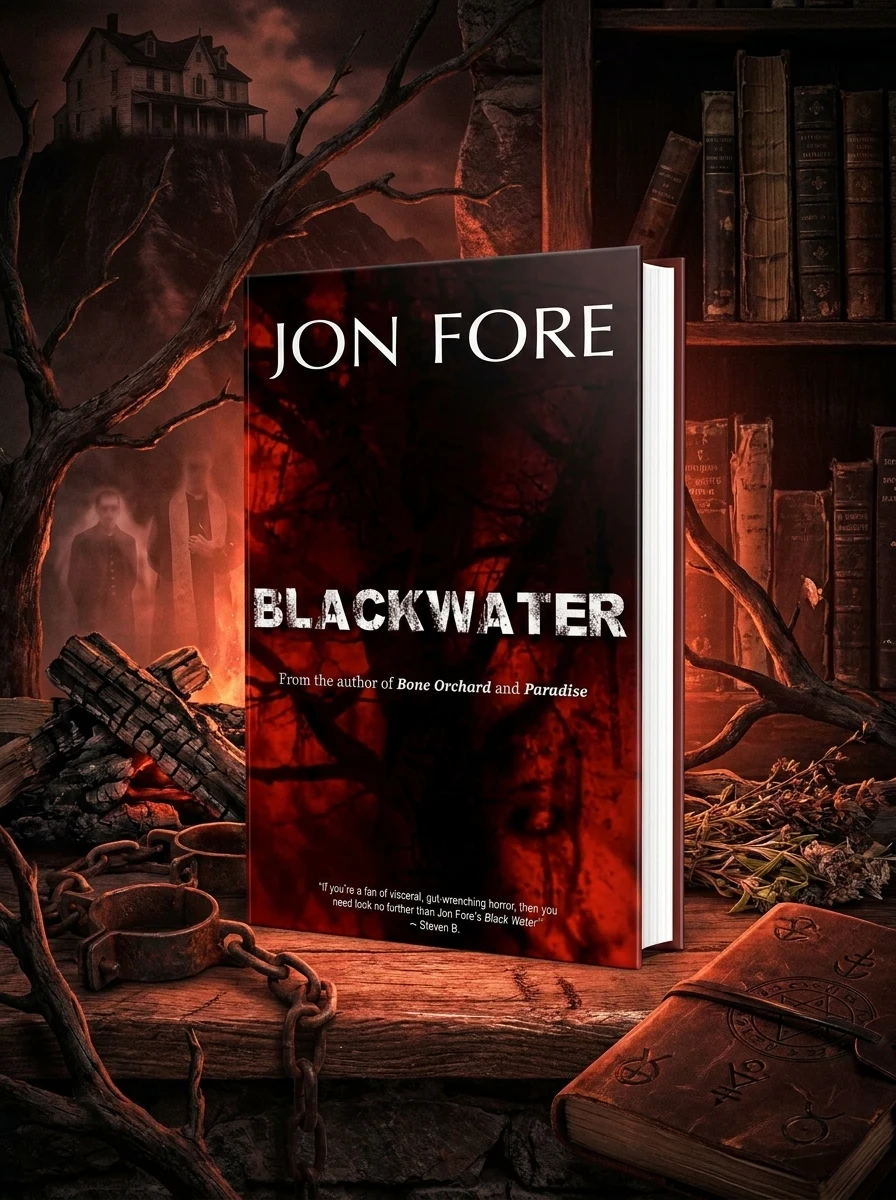
Black Water
A student group uncovers ancient horrors while documenting a haunted homestead.
Fore writes about students who visit Heart House to record its history. They find themselves trapped by the evil that once used the site for torture and imprisonment. The book connects colonial military secrets with Civil War era witch hunts. The horror arises from the land itself, not just ghosts. Readers follow the characters as they realize the legends are real. The story does not offer easy escapes or safe havens. The terror is tied to the specific geography of Black Water Mountain.
The narrative draws on American colonial and Civil War eras, specifically referencing a secret military prison and witch persecutions. It uses the Underground Railroad as a historical anchor for the Heart House location, blending these periods with supernatural folklore to create a sense of lingering dread in the landscape.


📝 Description: Black Water
💎 Our verdict on Black Water
📖 Why choose it
Why this book is worth reading
Readers who appreciate horror rooted in specific geography and historical weight will find this narrative compelling. It appeals to those who enjoy the slow burn of psychological dread rather than immediate shock, offering a deep dive into how legends can manifest as tangible threats. Fans of cosmic and gothic horror will value the connection between colonial military secrets and Civil War era witch hunts, seeing these elements not just as backdrop but as active sources of terror. The book is ideal for audiences seeking stories where the land itself is malevolent, providing a unique blend of academic curiosity and survival horror. It offers a satisfying experience for those who prefer their supernatural fiction grounded in dark folklore and tangible locations, ensuring the fear feels earned through the interaction between visitors and the haunted landscape.
⭐ Reader reviews
Reader rating
Fore effectively constructs an atmosphere of mounting dread by anchoring the horror in the tangible geography of Black Water Mountain. The narrative succeeds in blending colonial history with witchcraft lore, creating a sense that the evil is ancient and inescapable rather than merely spectral. By focusing on the interaction between the student group and the haunted homestead, the story maintains tension through the erosion of safety rather than jump scares. This approach suits readers who prefer slow-building psychological terror over fast-paced action. The book is best for enthusiasts of gothic and dark fantasy genres who enjoy historical settings that actively contribute to the supernatural threat. It delivers a cohesive experience where folklore and documented history collide, resulting in a chilling exploration of how past atrocities continue to haunt the present landscape.
📖 Read on the blog
🏛 Books from this publisher Createspace Independent Publishing Platform








You might also like
See more →

Have a question about this item?
Ask about the edition, condition, delivery or anything else — we reply by email or phone, usually within a day.
