
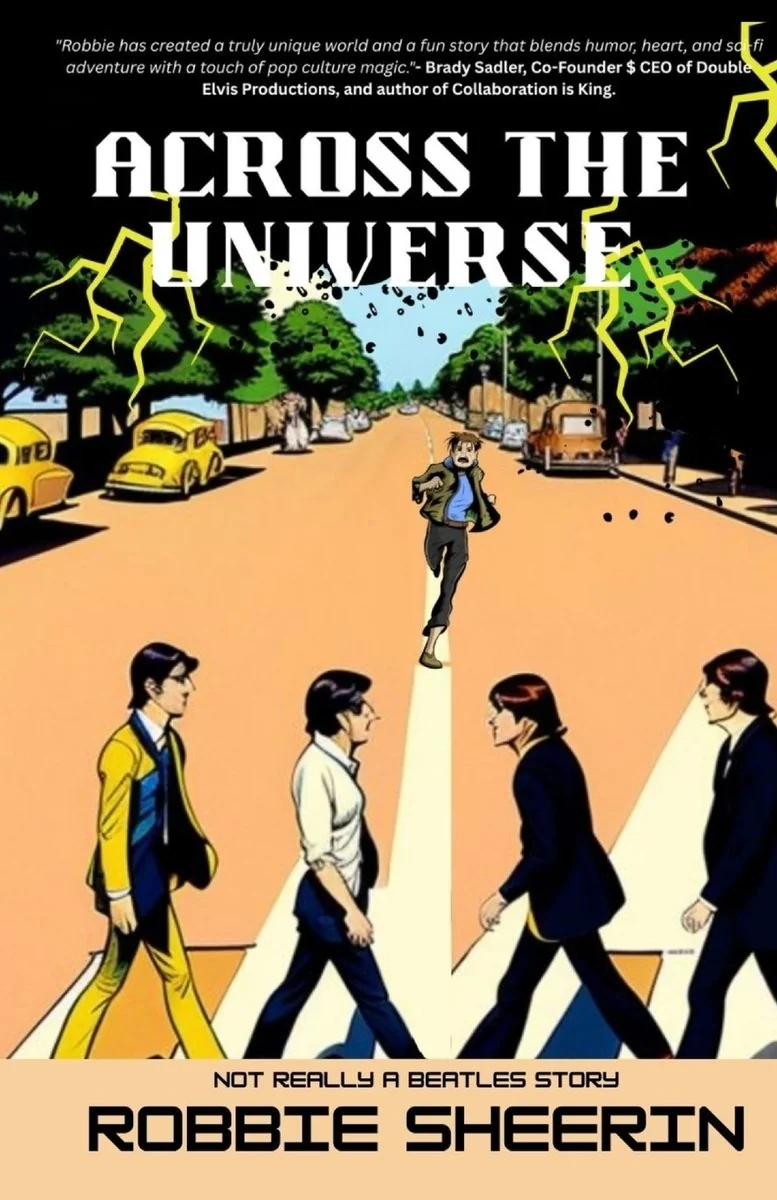
Across the Universe-Not Really a Beatles Story
A reporter discovers his illness links Beatles music to merging universes in this odd tale.
The narrative follows Edmond Moody, a selfish journalist whose cold symptoms reveal a multiversal crisis. He joins a mysterious woman and her friends to traverse these colliding realities. Their journey forces Moody to confront his flaws and learn the value of sacrifice. The story intertwines the fabric of alternate dimensions with the influence of Beatles songs. Sheerin uses this unique framework to examine how art impacts existence across different planes. The plot avoids traditional historical retelling in favor of a speculative exploration of connection and consequence.
Published in 2024, this work sits at the intersection of supernatural fiction and musical analysis. It draws on the cultural weight of the Beatles while exploring gothic themes of isolation and cosmic horror through a quirky, non-linear lens.


📝 Description: Across the Universe-Not Really a Beatles Story
💎 Our verdict on Across the Universe-Not Really a Beatles Story
📖 Why choose it
Why this book is worth reading
Readers seeking unconventional fiction that blends supernatural elements with musical history will find this narrative compelling. It appeals to those interested in quirky, mind-bending stories that challenge traditional storytelling structures. The book is ideal for individuals who enjoy speculative explorations of connection and consequence over straightforward chronicles. By focusing on personal growth against a backdrop of cosmic convergence, it offers a unique examination of how art impacts existence across different planes. This work suits those willing to engage with a premise where pop culture intersects with metaphysical theory, providing an intellectual yet eerie reading experience that diverges sharply from standard horror or biography.
⭐ Reader reviews
Reader rating
Sheerin constructs a bizarre yet thoughtful exploration of alternate realities through the lens of Beatles music. The narrative effectively uses Edmond Moody’s selfishness as a foil to the cosmic crisis he encounters, allowing for a study of personal growth amidst surreal circumstances. While it lacks the grounding realism preferred by some, its strength lies in its unique framework linking pop culture to metaphysical theory. This approach creates a distinct tone that is both intellectual and eerie. It best suits readers who appreciate mind-bending narratives and are open to unconventional horror that prioritizes thematic depth over traditional plot mechanics or historical accuracy regarding the band.
You might also like
See more →







Have a question about this item?
Ask about the edition, condition, delivery or anything else — we reply by email or phone, usually within a day.
