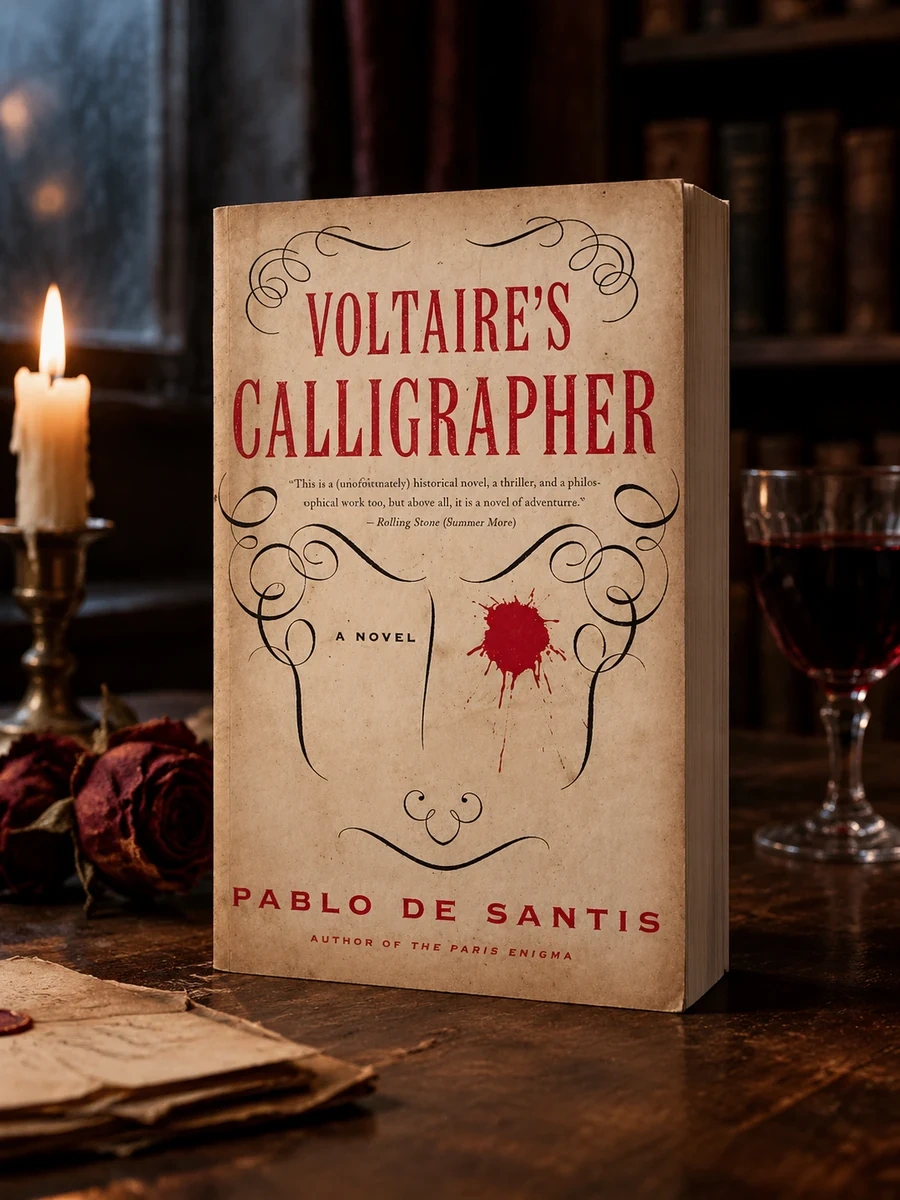

Voltaire's Calligrapher
A steampunk mystery centered on an 18th-century French calligrapher.
The narrative follows a renowned calligrapher in pre-revolution France as he confronts a complex mystery. De Santis uses the setting of the Enlightenment to explore the decline of traditional crafts. The story blends historical detail with steampunk elements, creating a unique atmosphere. The protagonist's expertise becomes central to solving the plot's conflicts. This approach offers a fresh perspective on historical fiction by focusing on an artisan rather than a political figure or soldier.
The novel is set in pre-revolution France during the height of the eighteenth century Enlightenment. This period emphasized reason and scientific progress, providing a stark contrast to the fading traditional craft of calligraphy explored in the story.


📝 Description: Voltaire's Calligrapher
💎 Our verdict on Voltaire's Calligrapher
📖 Why choose it
Why this book is worth reading
This book offers a refreshing perspective by focusing on an artisan rather than political figures or soldiers, appealing to those who enjoy character-driven plots centered on craftsmen. Readers interested in historical fiction that incorporates speculative elements like steampunk will find the unique atmosphere compelling. It is ideal for audiences seeking to explore the intersection of artistic tradition and technology without relying on traditional horror tropes. While those expecting fast-paced action or supernatural scares may find it less aligned with their expectations, this work provides a deep dive into the decline of traditional crafts through a breathless mystery. It suits readers who appreciate intricate plots within historical settings and wish to examine the role of a calligrapher amidst profound cultural changes.
⭐ Reader reviews
Reader rating
De Santis delivers a sophisticated narrative that prioritizes the protagonist's professional life over supernatural horror, creating a distinct steampunk mystery grounded in pre-revolutionary France. The novel excels in weaving historical detail with speculative elements to examine the decline of traditional crafts. It suits readers who appreciate character-driven plots focused on artisans and the intersection of artistry and technology. By avoiding conventional horror tropes, the story offers a fresh perspective on historical fiction, emphasizing cultural context over action. This approach rewards patience and attention to atmospheric world-building, making it a strong choice for those interested in the specific cultural shifts of the Enlightenment era and the fading role of skilled calligraphers.
📖 Read on the blog
✍️ More books by this author Pablo de Santis


🏛 Books from this publisher Harper Perennial


You might also like
See more →



Have a question about this item?
Ask about the edition, condition, delivery or anything else — we reply by email or phone, usually within a day.
