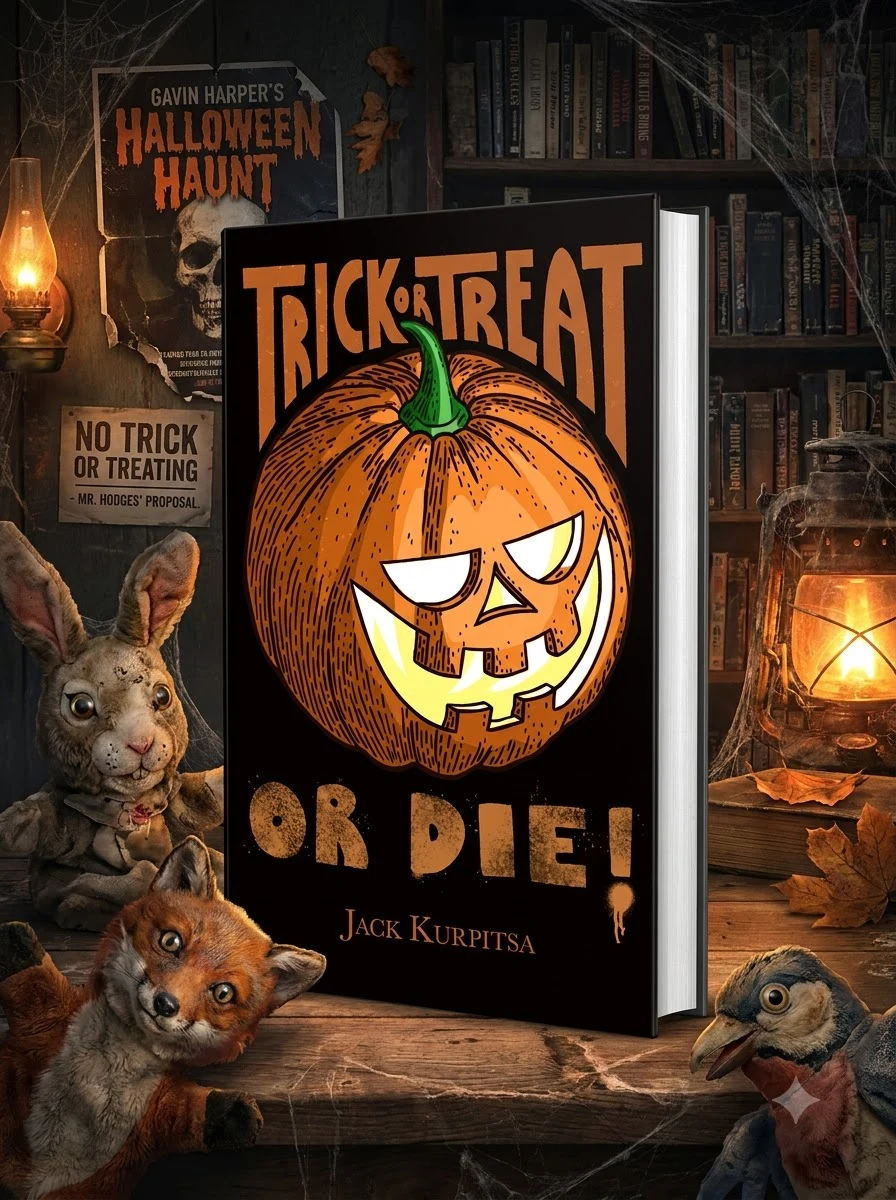
Trick or Treat or Die!
A teen puppeteer exploits town protests to unleash violence on Halloween.
Pennecott Stamp uses the chaos of a local ban on trick-or-treating as cover for his violent ambitions. Mr. Hodges pushes the ban to stop youth entitlement, sparking protests that distract the community. Gavin Harper and his friends attempt to continue their annual haunt amidst this turmoil. Pennecott sees the distraction as the perfect moment to act. He designs an explosion of violence while Gavin builds a maze. The story contrasts the constructive effort of creating a haunt with the destructive intent of its antagonist. Kurpitsa focuses on the psychological state of the killer and the social friction in the town. The narrative does not rely on supernatural elements but on human actions driven by dark impulses.
The story is set in a US town where Halloween haunt traditions clash with local political efforts to control youth behavior. The narrative draws on the cultural tension between festive community rituals and individual entitlement.


📝 Description: Trick or Treat or Die!
💎 Our verdict on Trick or Treat or Die!
📖 Why choose it
Why this book is worth reading
Readers who appreciate grounded psychological horror will find this narrative compelling due to its focus on human malice rather than otherworldly threats. The book offers a sharp examination of social friction, contrasting the constructive efforts of community tradition with the destructive impulses of individual rebellion. Those interested in the psychology of adolescent killers and the dynamics of town protests will gain insight into how chaos can be exploited for violent ends. It provides a tense exploration of how local disputes escalate into catastrophic events, appealing to fans who prefer realistic settings over gothic or cosmic elements.
⭐ Reader reviews
Reader rating
Kurpitsa delivers a tense, grounded narrative that effectively utilizes the chaos of a trick-or-treat ban to mask violent ambitions. The story excels in contrasting Gavin’s constructive haunt-building with Pennecott’s destructive planning, highlighting the intersection of youthful rebellion and community control. It avoids supernatural crutches, relying instead on psychological depth and social tension. This approach suits readers who prefer realistic horror driven by human actions. While it lacks historical gothic flair, its focus on the psychology of the killer and the impact of civic disputes makes it a strong choice for fans of modern, character-driven horror fiction.
📖 Read on the blog
🏛 Books from this publisher Independently Published








You might also like
See more →
Have a question about this item?
Ask about the edition, condition, delivery or anything else — we reply by email or phone, usually within a day.
