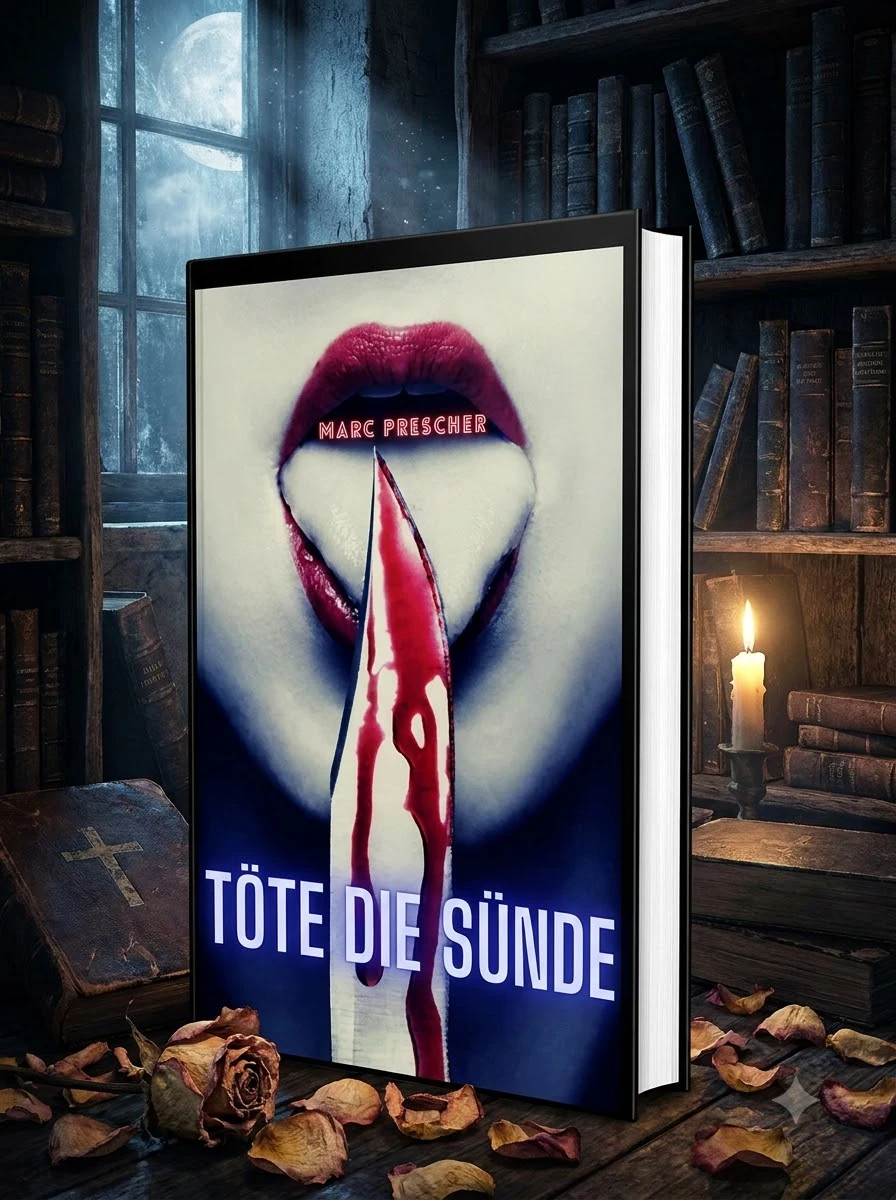
Tote die Sunde
A novel about a religious man driven to serial murder by divine voices.
Prescher’s narrative focuses entirely on the internal logic of Markus, who believes he is executing God’s will. The story does not provide external context for his actions but remains locked in his perspective. He identifies women as the source of moral decay and justifies their elimination through violent means. The plot tracks his progression from religious devotion to bloody action without judgment or resolution. This approach creates a claustrophobic experience that forces the reader to inhabit the mind of a killer who sees himself as righteous. The text relies on the tension between Markus’s piety and his atrocities to generate horror.
Published in 2021 by Independently Published, this work sits within the contemporary landscape of self-published horror fiction. It engages with German language traditions of gothic literature while addressing modern anxieties about faith and mental health through a fictional lens.


📝 Description: Tote die Sunde
💎 Our verdict on Tote die Sunde
📖 Why choose it
Why this book is worth reading
Readers interested in the psychological unraveling of religious extremism will find this narrative compelling. It offers a claustrophobic immersion into the mind of Markus, forcing an engagement with his internal logic without external judgment. The book appeals to those who enjoy deconstructing moral frameworks and exploring how divine whispers can manifest as violent crusades. It is suitable for audiences seeking intense character studies that blend gothic tradition with modern psychological horror. Those fascinated by the tension between piety and atrocity, or who appreciate narratives that refuse easy resolution, will gain insight into the terrifying plausibility of a killer’s self-righteousness.
⭐ Reader reviews
Reader rating
Prescher constructs a disturbingly intimate portrait of Markus, leveraging his internal monologue to create a suffocating atmosphere. The narrative succeeds in its goal by refusing to provide external context, thereby trapping the reader within the protagonist’s distorted worldview. This approach generates significant tension through the stark contrast between Markus’s self-perceived holiness and his horrific actions. The work is best suited for readers of psychological horror who appreciate complex, morally ambiguous protagonists. It avoids sensationalism in favor of a cold, clinical examination of psychosis driven by faith. While unsuitable for those seeking lighthearted supernatural tales or factual theological discourse, it stands as a potent example of dark fantasy that challenges the boundaries of religious morality and mental instability.
📖 Read on the blog
🏛 Books from this publisher Independently Published








You might also like
See more →

Have a question about this item?
Ask about the edition, condition, delivery or anything else — we reply by email or phone, usually within a day.
