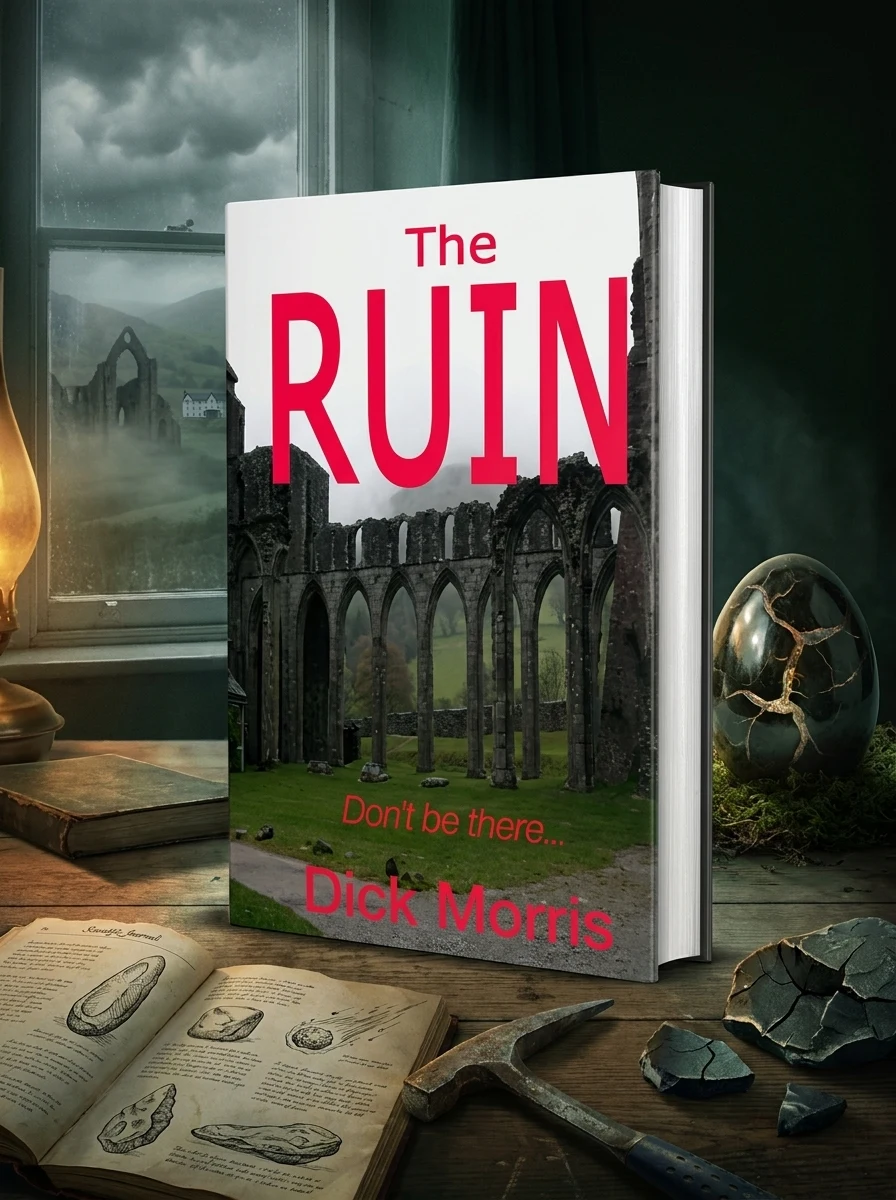
The Ruin: Don't be there!
A couple inherits a Welsh hotel and encounters a mysterious stone egg.
This narrative follows Mike and Geraldine Baker as they take over a hotel in a secluded Welsh valley. Their routine is disrupted by the arrival of a strange object in a nearby field. While Mike believes it is a meteorite, his dreams suggest it is an egg. Geraldine questions this theory, noting that stone eggs do not exist. The story unfolds through the perspectives of locals and tourists visiting the ruin. As the object's true nature reveals itself, the environment changes drastically. The valley becomes a place of fear rather than beauty. Morris constructs the plot around the slow realization of danger. The tension builds through the characters' interactions with the anomaly. The ending leaves the full scope of the horror implied by the title.
The story is set in a remote Welsh valley, drawing on British gothic traditions of isolated settings and local folklore. It combines elements of supernatural fiction with cosmic horror tropes popular in late twentieth-century literature.


📝 Description: The Ruin: Don't be there!
💎 Our verdict on The Ruin: Don't be there!
📖 Why choose it
Why this book is worth reading
Readers who appreciate slow-burn psychological horror and atmospheric dread will find this book rewarding. It appeals to those who enjoy stories where the environment itself becomes a source of terror, rather than relying on jump scares or gore. The narrative’s focus on isolation and the gradual unraveling of reality suits fans of cosmic horror who prefer implied menace over explicit exposition. Those interested in the intersection of geological anomalies and supernatural fear will also find value in its unique premise.
⭐ Reader reviews
Reader rating
Dick Morris constructs a compelling tale of psychological unease through the lens of cosmic horror. The book excels at building tension via the characters' interactions with an anomalous object, transforming a peaceful Welsh valley into a landscape of fear. Morris effectively uses the disconnect between scientific rationalization and supernatural reality to drive the plot forward. This approach creates a lingering sense of dread that lingers long after the final page. It is best suited for readers who enjoy atmospheric storytelling and thematic depth over fast-paced action or clear explanations of the unknown phenomena.
📖 Read on the blog
🏛 Books from this publisher Createspace Independent Publishing Platform








You might also like
See more →

Have a question about this item?
Ask about the edition, condition, delivery or anything else — we reply by email or phone, usually within a day.
