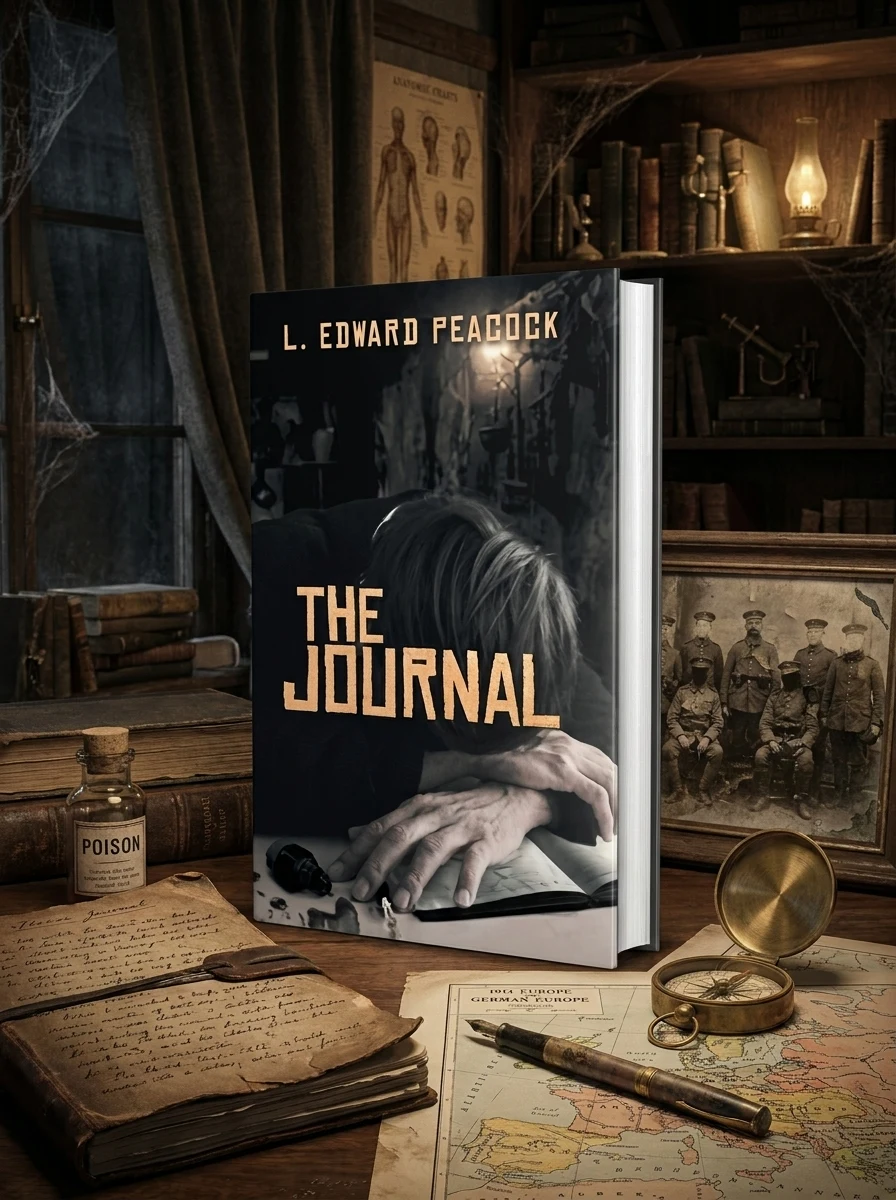
The Journal
A professor's wartime journal reveals a supernatural inheritance passed to his grandson.
The narrative centers on Gerald Houston Farnsworth, whose experience in 1914 shapes a family curse. He joins a special group to study German tactics and witnesses the creation of new deadly methods. The horror extends beyond the battlefield into his home life. His first wife dies trying to stop an evil from being born. This event triggers a chain of events that Gerald records for his grandson. The grandson faces the responsibility of controlling this inherited evil. The story connects military history with supernatural consequences. It examines how trauma can manifest as a tangible threat. The plot moves from the trenches of Europe to the domestic sphere. Peacock uses the journal format to frame these personal revelations. The text suggests that some horrors cannot be left behind in war. The grandson must act to save others from this legacy.
The story is set in 1914 during World War I. Gerald Houston Farnsworth serves as a professor from West Point. He observes the German war machine and its tactics. The narrative bridges military history with supernatural fiction traditions.


📝 Description: The Journal
💎 Our verdict on The Journal
📖 Why choose it
Why this book is worth reading
Readers interested in the intersection of historical military analysis and supernatural horror will find this narrative compelling. It offers a unique perspective on World War I, moving beyond battlefield tactics to explore how trauma manifests as a tangible threat within the domestic sphere. Those who appreciate gothic elements rooted in family curses and inherited evil will engage with Gerald Houston Farnsworth’s personal testimony. The book appeals to audiences seeking lighthearted adventure avoidance, preferring heavy, subjective accounts of early twentieth-century horrors. It is ideal for fans of dark fantasy and true crime who enjoy examining how past atrocities influence present-day consequences through a lens of psychological dread.
⭐ Reader reviews
Reader rating
Peacock effectively frames his narrative as a personal chronicle, allowing the horror to seep from the trenches of Europe into the safety of home life. The structure works well to convey the weight of inherited guilt and supernatural burden. Gerald’s account provides a subjective view of the era's devastation, emphasizing psychological over purely physical dangers. While the tone is undeniably heavy, it suits those seeking depth in gothic horror. The connection between military history and domestic tragedy is handled with care, avoiding sensationalism for atmospheric dread. This approach creates a cohesive story about the persistence of evil across generations. It stands as a solid entry for collectors of cosmic and psychological horror who value historical context in their spooky tales.
📖 Read on the blog
✍️ More books by this author L Edward Peacock







🏛 Books from this publisher Primix Publishing


You might also like
See more →


Have a question about this item?
Ask about the edition, condition, delivery or anything else — we reply by email or phone, usually within a day.
