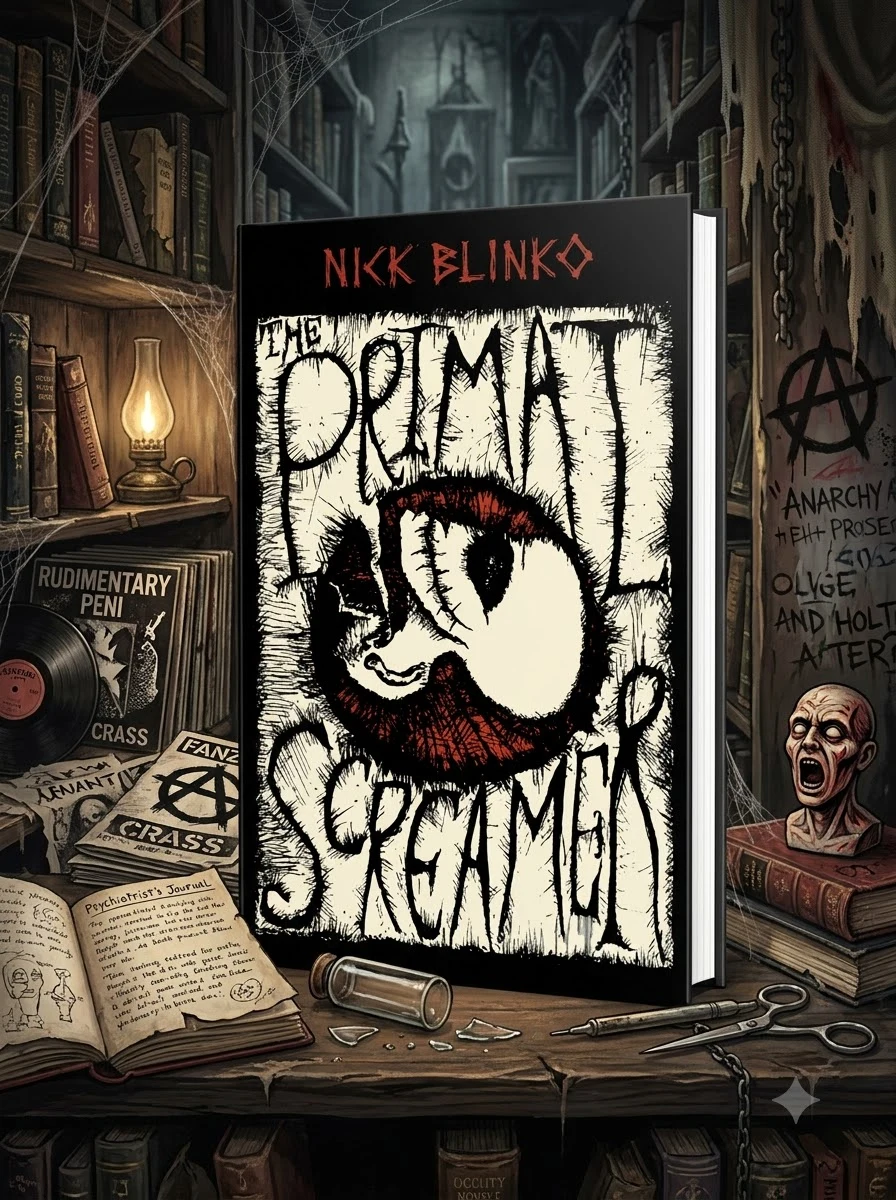

Primal Screamer
A diary-style novel merging Gothic horror with UK anarcho-punk culture.
This work functions as a literary artifact from the early 1980s English underground. It documents the collapse of a psychiatrist’s mind while treating a patient deeply embedded in the nascent anarcho-punk scene. The narrative relies on the perspective of Dr. Rodney H. Dweller, who records his observations of Nathaniel Snoxell’s decline. The story moves from 1979 to 1985, capturing the era’s squatted Anarchy Centers and EP recordings. Blinko uses this framework to explore themes of suicide and insanity within a specific political context. The inclusion of original artwork provides visual support for the text’s dark atmosphere.
The novel is set in the squats and psychiatric institutions of early 1980s England. It captures the specific moment when the UK anarcho-punk scene was forming, linking the aesthetic of Crass with Lovecraftian horror traditions.


📝 Description: Primal Screamer
💎 Our verdict on Primal Screamer
📖 Why choose it
Why this book is worth reading
This book offers a distinct experience for readers interested in the convergence of psychiatric history and underground music scenes. It appeals to those who appreciate the literary artifact aspect of horror, providing insight into the collapse of a psychiatrist’s mind while treating a patient embedded in the nascent anarcho-punk scene. The narrative structure, presented as a medical diary, allows for a deep exploration of severe mental distress through the lens of political rebellion. Readers seeking to understand the cultural context of squatted Anarchy Centers and EP recordings from 1979 to 1985 will find value in its unique perspective. It is ideal for those who enjoy dark fantasy and gothic themes that are intertwined with real-world subcultural movements, offering a glimpse into the era's ideological fervor.
⭐ Reader reviews
Reader rating
Blinko presents a semi-autobiographical Gothic horror novel that effectively merges Lovecraftian cosmic dread with the visceral energy of punk culture. The diary format creates an intimate yet unsettling atmosphere, documenting the psychological decline of both patient and doctor against a backdrop of political unrest. While the focus on anarchist ideology and clinical observation may alienate those seeking traditional plot-driven horror, it succeeds as a compelling study of insanity within a specific historical context. The inclusion of original artwork enhances the dark tone, supporting the text’s exploration of suicide and madness. This work is best suited for readers comfortable with non-political narrative expectations being challenged by dense thematic material.
You might also like
See more →






Have a question about this item?
Ask about the edition, condition, delivery or anything else — we reply by email or phone, usually within a day.
