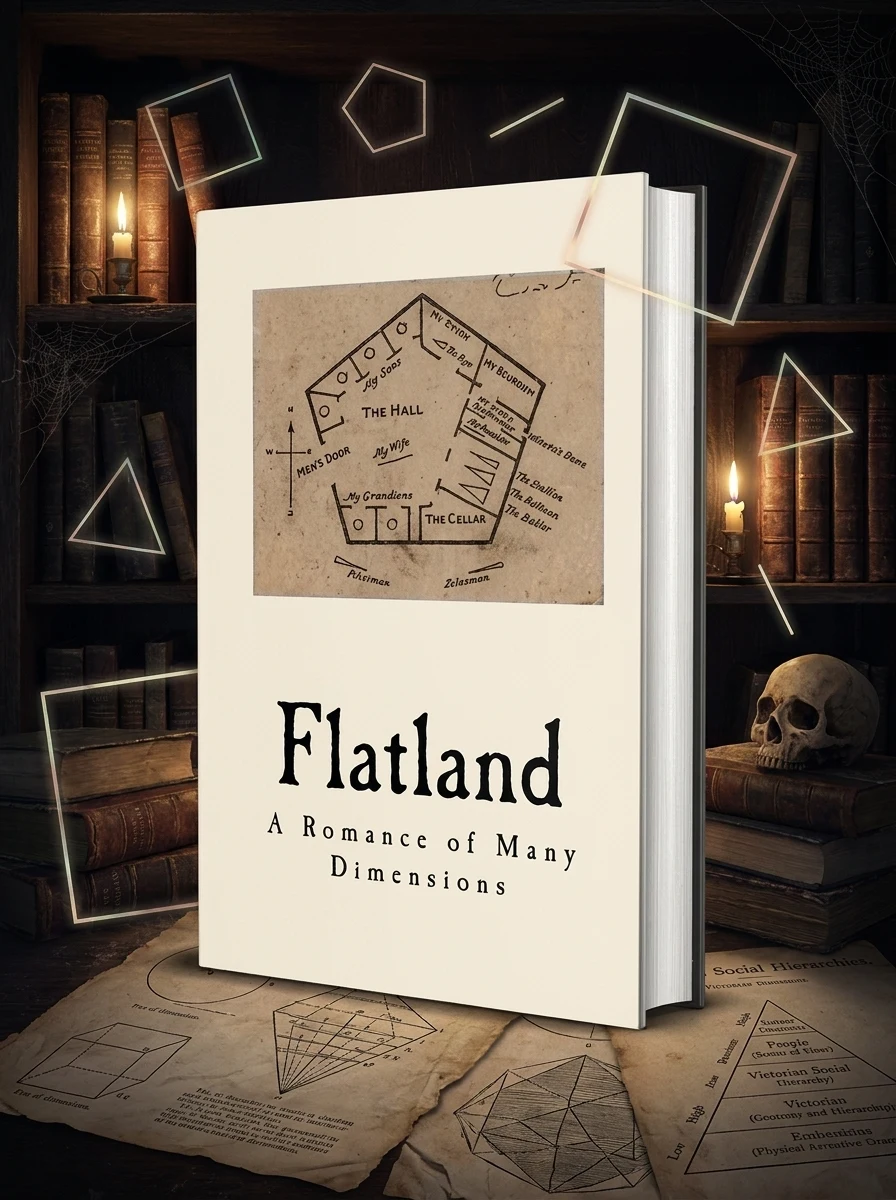
Flatland: A Romance of Many Dimensions
A satirical novella exploring two-dimensional life and social hierarchy through geometric figures.
Abbott constructs a fictional world inhabited by geometric shapes to critique Victorian social structures. The narrator, A Square, guides the reader through the rules of this flat existence. He details how gender and class are determined by the number of sides one possesses. The narrative shifts from daily practicalities to a historical timeline ending in 1999. This progression allows Abbott to explore how different perspectives shape understanding of reality. The work relies on mathematical logic to drive its social satire.
Written by English schoolmaster Edwin A Abbott and first published in 1884 by Seeley & Co. of London, the novella uses a two-dimensional setting to comment on the hierarchy of Victorian culture.


📝 Description: Flatland: A Romance of Many Dimensions
💎 Our verdict on Flatland: A Romance of Many Dimensions
📖 Why choose it
Why this book is worth reading
Readers interested in the intersection of geometry, sociology, and Victorian literature will find this novella uniquely rewarding. Abbott constructs a fictional world where social status is determined by geometric shape, offering a sharp critique of class and gender norms. While it lacks traditional horror elements, its exploration of perception and reality through mathematical logic provides a profound intellectual experience. Those who appreciate speculative fiction that challenges understanding of the physical world will gain much from this text. It serves as an essential examination of how beings perceive their confined realities, making it valuable for those seeking depth beyond standard genre thrills.
⭐ Reader reviews
Reader rating
Abbott’s Flatland excels in its satirical construction of a two-dimensional universe to mirror Victorian social structures. The narrative effectively uses geometric figures to critique hierarchy, presenting a rigid society defined by polygon sides and gender roles. While the tone is academic rather than thrilling, it succeeds as a significant contribution to dimensional theory and social commentary. This work best suits readers who enjoy speculative fiction blending mathematics with sociology. It may disappoint those seeking supernatural horror or fast-paced plots, but it remains a vital text for understanding perspective and reality through a unique, logical lens.
📖 Read on the blog
🏛 Books from this publisher Createspace Independent Publishing Platform




You might also like
See more →


Have a question about this item?
Ask about the edition, condition, delivery or anything else — we reply by email or phone, usually within a day.
