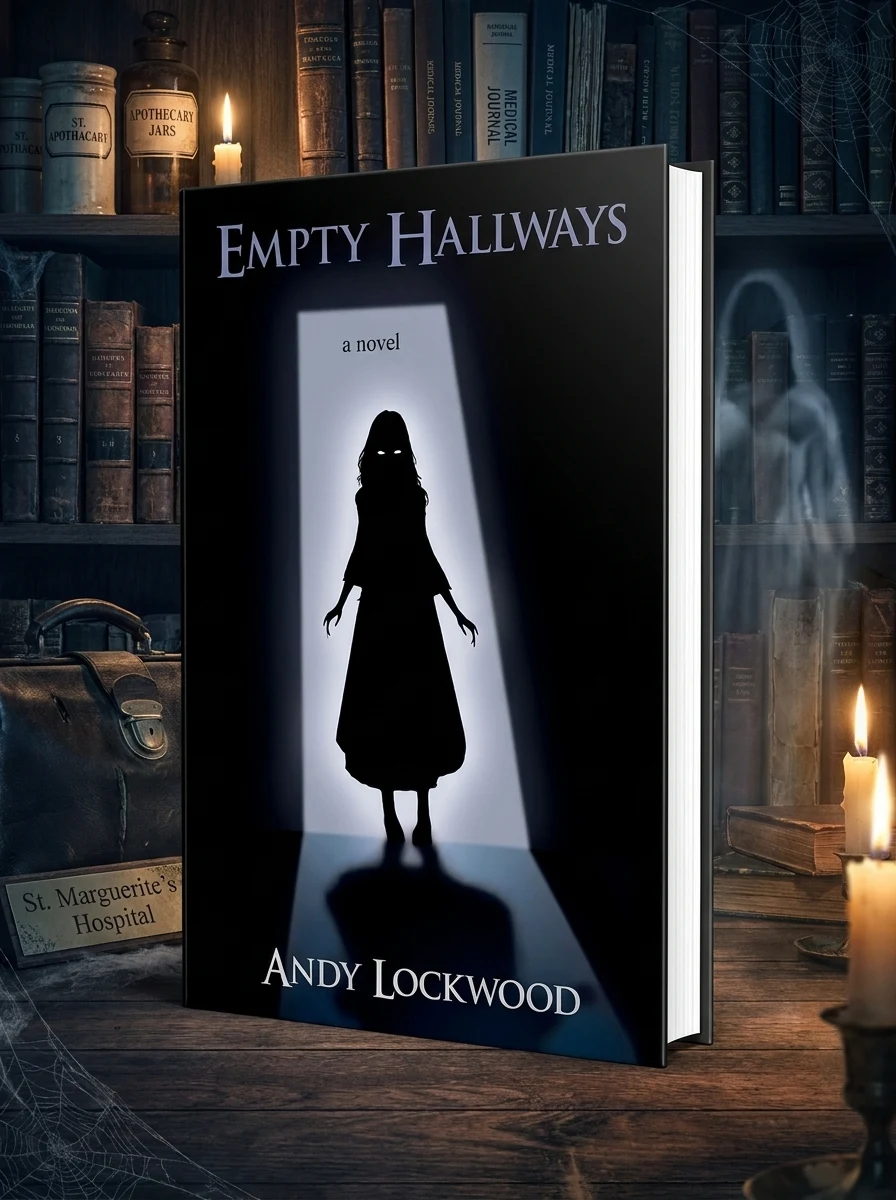

Empty Hallways
A haunted hospital story where personal trauma awakens a vengeful spirit.
The narrative follows David Hartlet as he enters St. Marguerite's Hospital under the care of Dr. Schraeder. While the doctor dismisses David's fears as mental instability, a historical tragedy within the building begins to manifest physically. The spirit of the hospital demands revenge, targeting those who dwell there. As David’s condition worsens, the boundary between his internal struggles and the external haunting blurs. The story explores how unresolved grief can attract malevolent forces. It does not rely on jump scares but rather on a slow-building dread. The characters must uncover the truth of the past to survive the present threat.
Published in 2013 by Andy Lockwood, this work sits within the American independent horror fiction tradition. It draws on gothic literature tropes of isolated institutions and psychological dread. The text reflects a period where authors explored the ambiguity between clinical diagnosis and supernatural reality.


📝 Description: Empty Hallways
💎 Our verdict on Empty Hallways
📖 Why choose it
Why this book is worth reading
Readers who appreciate atmospheric horror that prioritizes slow-building dread over cheap jump scares will find this narrative compelling. It is ideal for those interested in the intersection of psychological trauma and supernatural phenomena, offering a nuanced exploration of how personal demons can attract external evil. The story appeals to fans of isolated setting horrors where the environment plays an active role in the terror. Those who enjoy complex dynamics between patients and doctors in clinical environments will also benefit from its tense, claustrophobic atmosphere. It is not suitable for those seeking lighthearted tales or purely scientific explanations, but rather offers a heavy, unresolved confrontation with past actions.
⭐ Reader reviews
Reader rating
Lockwood crafts a chilling gothic narrative that effectively blurs the line between internal psychological struggle and external supernatural threat. By centering the plot on David Hartlet’s descent within St. Marguerite’s Hospital, the author creates a palpable sense of isolation and dread. The book excels in its examination of how unresolved grief can serve as a conduit for malevolent forces, avoiding reliance on sensationalism in favor of gradual revelation. This approach suits readers who enjoy atmospheric horror where the setting is an active participant in the terror. It is particularly well-suited for audiences interested in the dynamics of mental illness and the secrets buried within isolated institutions. The narrative offers no easy answers, demanding that characters confront the reality behind their fears.
You might also like
See more →




Have a question about this item?
Ask about the edition, condition, delivery or anything else — we reply by email or phone, usually within a day.
