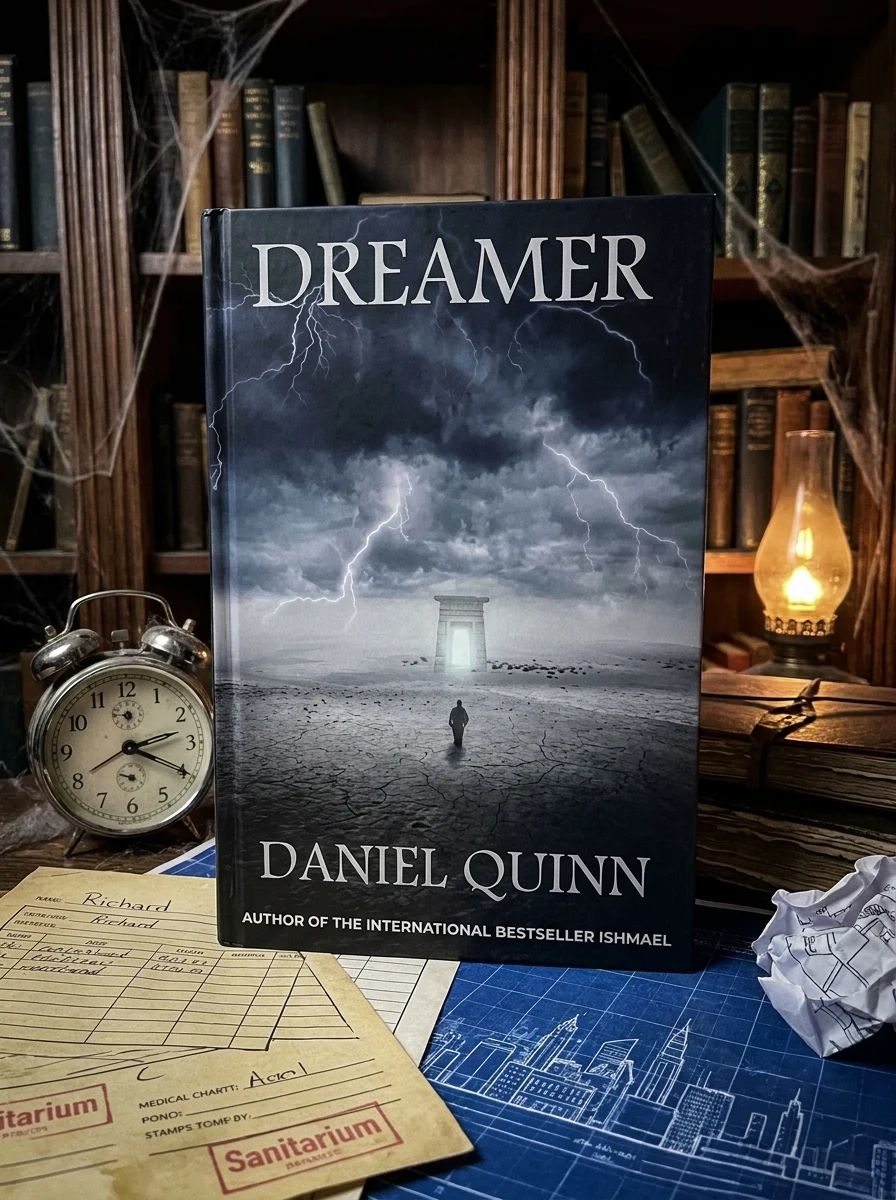
Dreamer
A man chases his lover in dreams only to wake as her husband in a sanitarium.
Greg pursues Ginny Winters through empty streets until he wakes as Richard, a patient married to her. This shift forces a confrontation with identity and madness. Quinn links this early work to his later Turner Award-winning novel Ishmael. The narrative structure mirrors the protagonist’s fractured psyche. Readers must decide which version of events holds weight. The sanitarium provides a backdrop for examining emotional disturbance. The deserted city represents the void left by lost memories. Ginny remains the constant variable in both scenarios.
Daniel Quinn published this work in 2013 through Createspace Independent Publishing Platform. It stands as an early exploration of themes he would later refine in his Turner Award-winning book Ishmael. The text reflects a period where independent publishing allowed for more experimental psychological narratives outside traditional horror tropes.


📝 Description: Dreamer
💎 Our verdict on Dreamer
📖 Why choose it
Why this book is worth reading
Readers who appreciate complex narrative structures and psychological depth will find this text compelling. It offers a rigorous examination of how identity fractures under extreme emotional pressure, appealing to those interested in the intersection of romance and institutional horror. The book demands patience with ambiguity and attention to detail, rewarding those willing to question the nature of love when the self is unknown. It is ideal for audiences seeking intellectual engagement over straightforward supernatural thrills, providing a unique perspective on memory, madness, and the void left by lost memories through its precise presentation of a psychological puzzle.
⭐ Reader reviews
Reader rating
Daniel Quinn presents a sophisticated exploration of mental disorientation and fractured identity. By blurring the lines between dreamer and patient, lover and prisoner, the narrative creates a tense atmosphere where reality is constantly questioned. The sanitarium setting effectively mirrors the isolation of the protagonist’s internal state, while the deserted city represents the void of lost memories. This approach suits readers who enjoy analyzing the fragility of memory and the ambiguity of truth. It may disappoint those seeking easy answers or traditional horror tropes, but it succeeds as a precise study of emotional disturbance. The work challenges readers to decide which version of events holds weight, making it a stimulating choice for fans of psychological horror and gothic fiction.
📖 Read on the blog
🏛 Books from this publisher Createspace Independent Publishing Platform




You might also like
See more →




Have a question about this item?
Ask about the edition, condition, delivery or anything else — we reply by email or phone, usually within a day.
