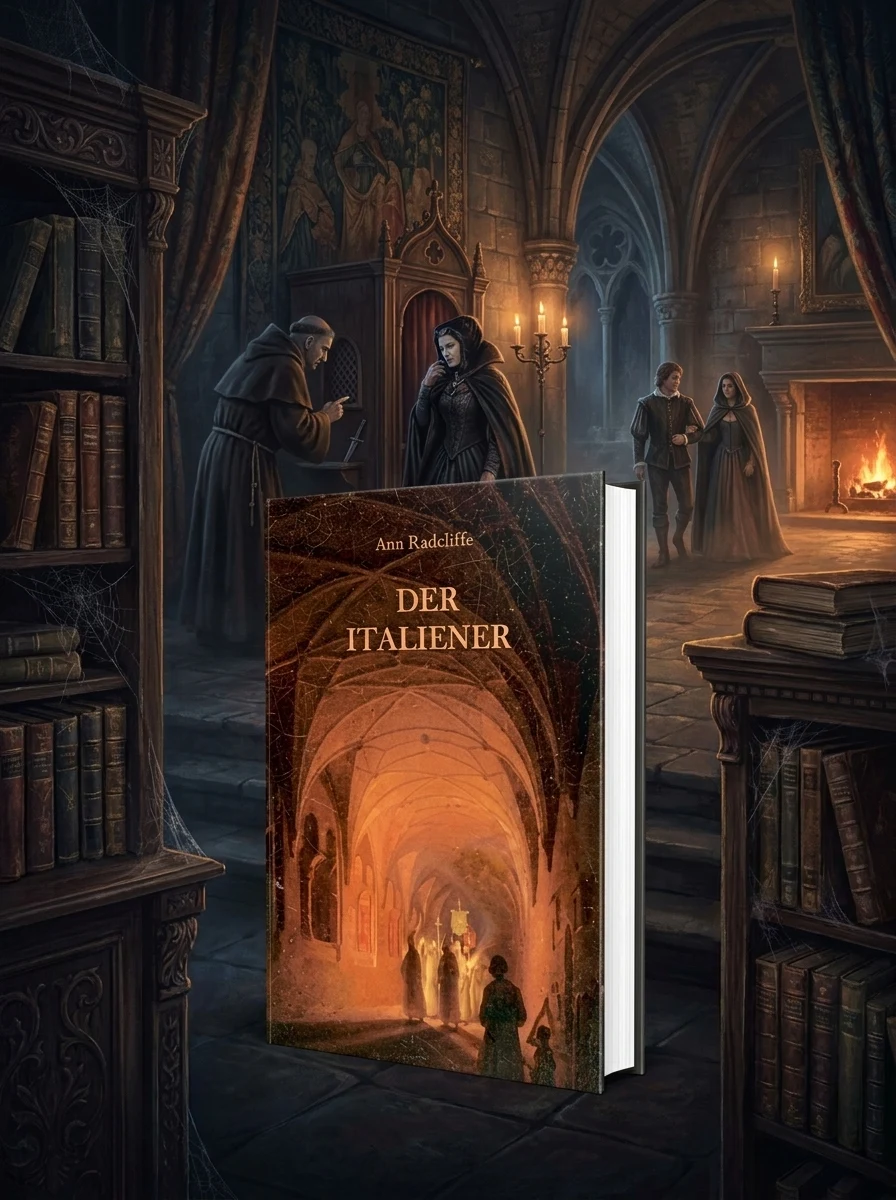

Der Italiener oder Der Beichtstuhl der Schwarzen Bussenden
A Gothic romance edited by Maria Weber featuring Ellena Rosalba and Vincentio di Vivaldi.
This volume captures the tension between personal desire and social hierarchy in eighteenth-century Italy. The conflict arises when the Marchesa uses her confessor, Schedoni, to sabotage the relationship between her son and a commoner. The narrative relies on the classic Gothic formula of threatened virtue and hidden malice within religious institutions. It provides insight into how class distinctions drove dramatic plots in early horror fiction. The text remains faithful to the original 1797 publication while offering a fresh translation perspective.
The story is set in Italy during the Inquisition period, specifically beginning in 1758. It draws on the late eighteenth-century Gothic tradition established by Ann Radcliffe in 1797. This edition serves as part of a comprehensive German-language collection edited by Maria Weber.


📝 Description: Der Italiener oder Der Beichtstuhl der Schwarzen Bussenden
💎 Our verdict on Der Italiener oder Der Beichtstuhl der Schwarzen Bussenden
📖 Why choose it
Why this book is worth reading
Readers with an interest in the foundational elements of Gothic horror and the evolution of psychological tension will find this text particularly rewarding. It offers a direct window into late eighteenth-century literary traditions, specifically how authors utilized religious manipulation and familial opposition to create dramatic plots. Those who appreciate the classic formula of threatened virtue and the intricate interplay between social status and personal desire will gain insight into the historical roots of horror fiction. This book is ideal for scholars or enthusiasts seeking to understand how early narratives framed class conflict through supernatural and psychological undertones, providing a faithful representation of the genre's origins without modern pacing adjustments.
⭐ Reader reviews
Reader rating
This edition serves as a vital resource for understanding the structural conventions of early Gothic romance. The narrative effectively captures the claustrophobic tension between individual passion and societal expectation, anchored by the conflict involving a proud Marchesa and a dark confessor. While it lacks modern pacing, its value lies in preserving the grand romantic elements and historical intrigue characteristic of 1797 publications. It suits readers interested in literary history, religious themes in horror, and the development of the villainous antagonist trope. Those seeking fast-paced action or non-European settings may find the pace deliberate, but for students of the genre, it remains a compelling artifact of its time.
📖 Read on the blog
✍️ More books by this author Maria Weber


🏛 Books from this publisher Bod - Books on Demand





You might also like
See more →



Have a question about this item?
Ask about the edition, condition, delivery or anything else — we reply by email or phone, usually within a day.
