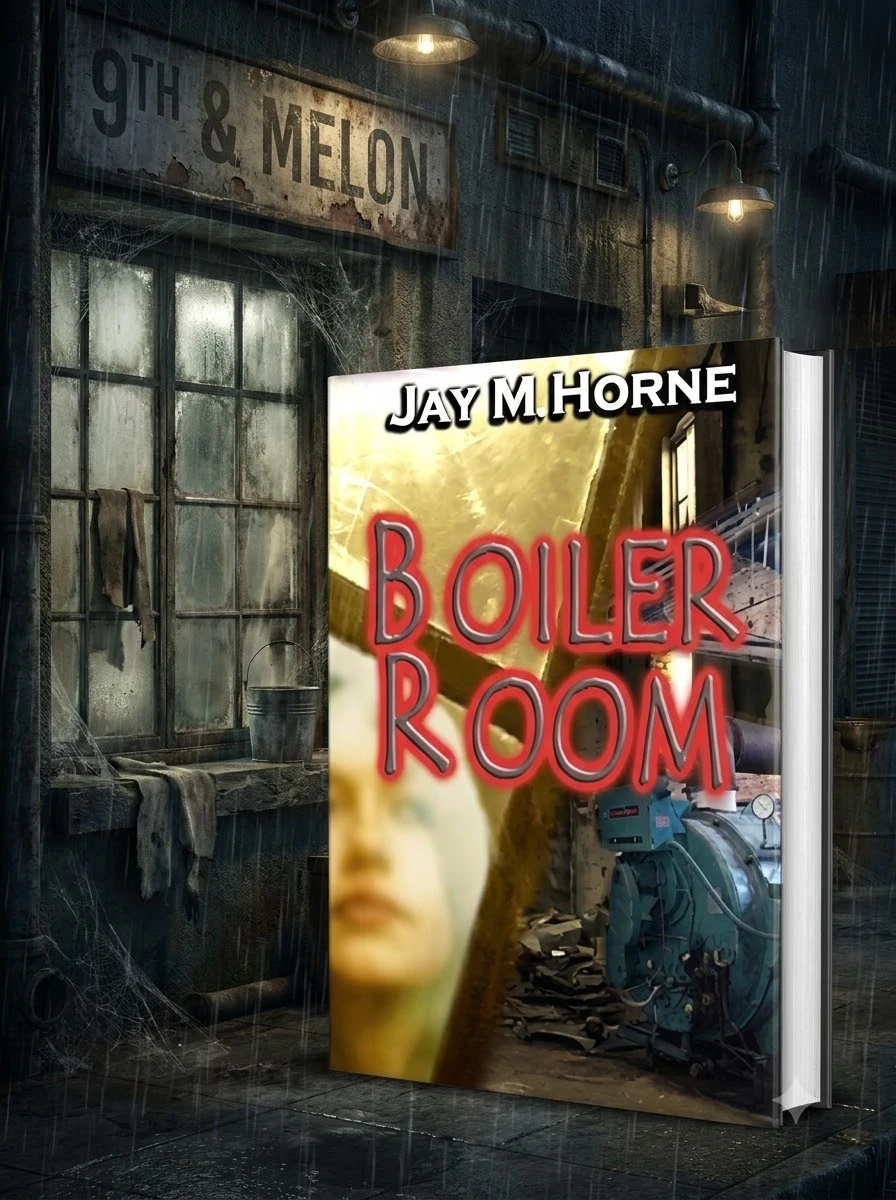
Boiler Room
A high school student faces a haunted warehouse boiler room assigned by her coach.
This work examines how local legends persist in modern settings through the eyes of a reluctant participant. Margaret’s assignment forces her to engage with the dilapidated warehouse on 9th and Melon, a place defined by its avoidance rather than its use. The narrative explores the intersection of school obligations and community warnings. Horne uses the specific detail of non-fogging windows to illustrate the supernatural element without resorting to gore or explicit violence. The story reflects a period where industrial decline leaves behind spaces ripe for ghost stories. It appeals to those who enjoy concise horror that relies on atmosphere and established folklore rather than complex plotting.
Published in 2020 by an independent publisher, this title fits within the contemporary resurgence of short-form horror fiction. It draws on American small-town mythology where industrial sites become vessels for collective fear. The work reflects a period where digital isolation makes physical spaces like abandoned warehouses feel more ominous and disconnected from everyday life.


📝 Description: Boiler Room
💎 Our verdict on Boiler Room
📖 Why choose it
Why this book is worth reading
This book is ideal for readers who appreciate concise, atmospheric horror tales rooted in established folklore rather than complex plotting. It appeals to those interested in how local legends persist within modern settings and the intersection of school obligations with community warnings. The narrative focuses on architectural decay mirroring psychological unease, offering a steady exploration of isolation and collective memory without relying on gore or explicit violence. It is particularly suitable for enthusiasts of gothic and ghost stories who enjoy the tension between adolescent skepticism and deeply rooted superstition. Those seeking extensive world-building may find the scope limited, but fans of short, impactful narratives will find value in its examination of haunted machinery and the weight of historical avoidance.
⭐ Reader reviews
Reader rating
Horne delivers a focused narrative that prioritizes atmosphere over intricate character development, effectively capturing the dread of a neglected industrial space. The story succeeds by leveraging the specific detail of non-fogging windows to illustrate supernatural elements subtly, avoiding reliance on shock tactics or explicit violence. It maintains a steady tension between Margaret’s internal debate and the external pressure of community warnings. This approach suits readers who enjoy concise horror grounded in American small-town folklore. While it lacks extensive world-building, its strength lies in its ability to mirror psychological unease through architectural decay. The work is a solid entry for those who prefer established tropes executed with precision rather than ambitious, sprawling sagas.
📖 Read on the blog
✍️ More books by this author Jay Horne



🏛 Books from this publisher Independently Published






You might also like
See more →
Have a question about this item?
Ask about the edition, condition, delivery or anything else — we reply by email or phone, usually within a day.
