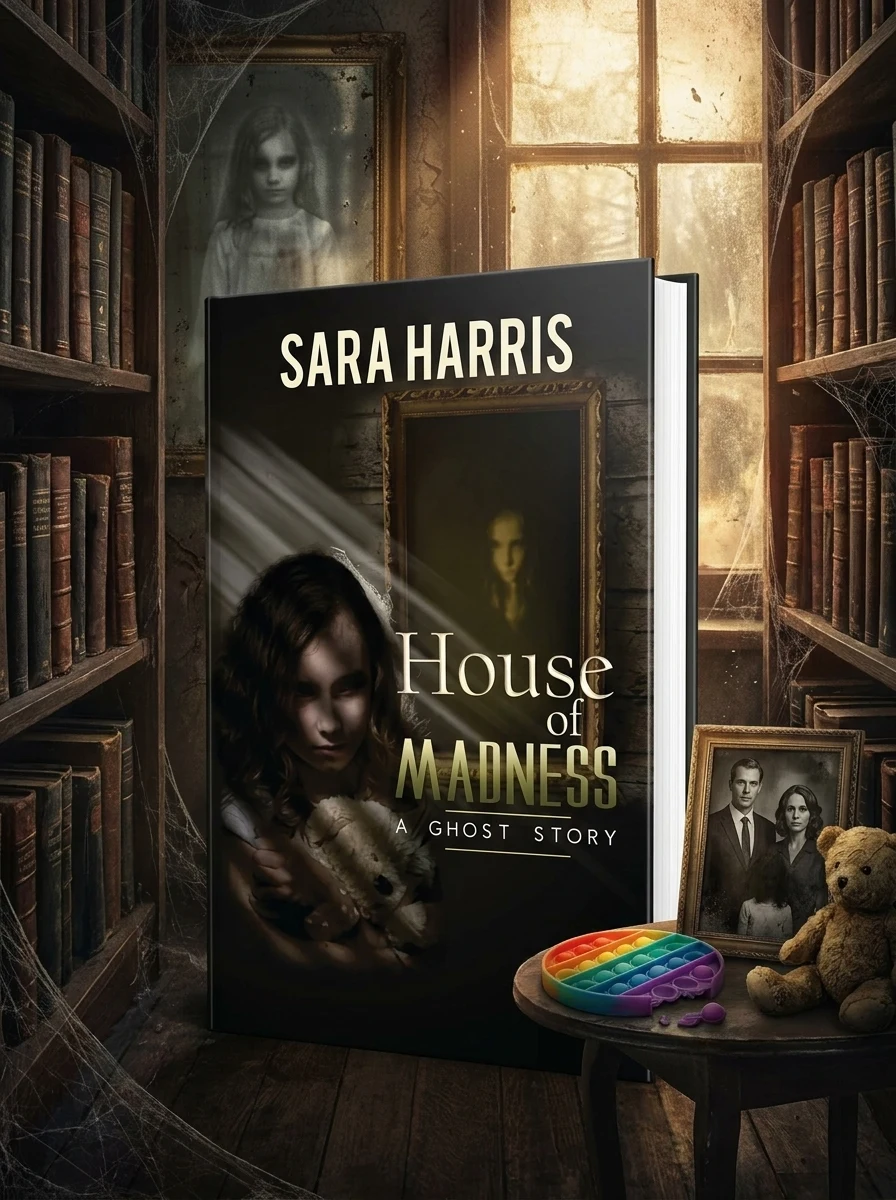
House of Madness
A family grapples with grief and guilt through the lens of sensory processing challenges.
The narrative focuses on the Smithfield household, where Tim and Adelaide struggle to cope with past losses. Their daughter Michaela faces sensory processing difficulties while carrying guilt for her parents' unhappiness. Harris uses this dynamic to explore how trauma affects family bonds. The story does not rely on external monsters but on the internal haunting of memory and misunderstanding. It is a study of how children interpret adult pain and how that interpretation shapes their own behavior. The work highlights the quiet horror of domestic isolation and the weight of unspoken secrets.
This 2019 release from Wordcrafts Press sits within contemporary American horror fiction. It reflects modern interests in psychological trauma and neurodiversity, moving away from traditional gothic tropes to focus on the haunting nature of memory and family dynamics.


📝 Description: House of Madness
💎 Our verdict on House of Madness
📖 Why choose it
Why this book is worth reading
Readers drawn to character-driven horror and psychological drama will find this narrative compelling. It offers a profound study of how grief and disability intersect within a household, exploring the isolation that accompanies unspoken trauma. Those interested in how children internalize parental pain and interpret adult sorrow will appreciate the nuanced portrayal of Michaela’s experience. The book is ideal for audiences seeking a quiet, atmospheric tension rooted in domestic reality rather than supernatural spectacle. It provides insight into the weight of memory and the barriers created by sensory overload, appealing to those who value emotional depth and subtle psychological horror over action.
⭐ Reader reviews
Reader rating
Harris crafts a poignant exploration of the Smithfield household, focusing on the emotional weight carried by Tim and Adelaide. The narrative effectively shifts attention to Michaela, whose sensory processing challenges and guilt create a palpable psychological tension. By treating the home as a vessel for haunting through emotional rather than spectral means, the author highlights the quiet horror of domestic isolation. The work succeeds in examining how grief affects family bonds without relying on external monsters. It suits readers who appreciate slow-burn psychological drama and character studies. However, those seeking fast-paced action or traditional supernatural elements may find the focus on internal struggle less engaging. A thoughtful, grounded contribution to the genre.
📖 Read on the blog
✍️ More books by this author Sara Harris


🏛 Books from this publisher Wordcrafts Press
You might also like
See more →

Have a question about this item?
Ask about the edition, condition, delivery or anything else — we reply by email or phone, usually within a day.
